Stepper vs Servo Motor: How to Choose the Right One
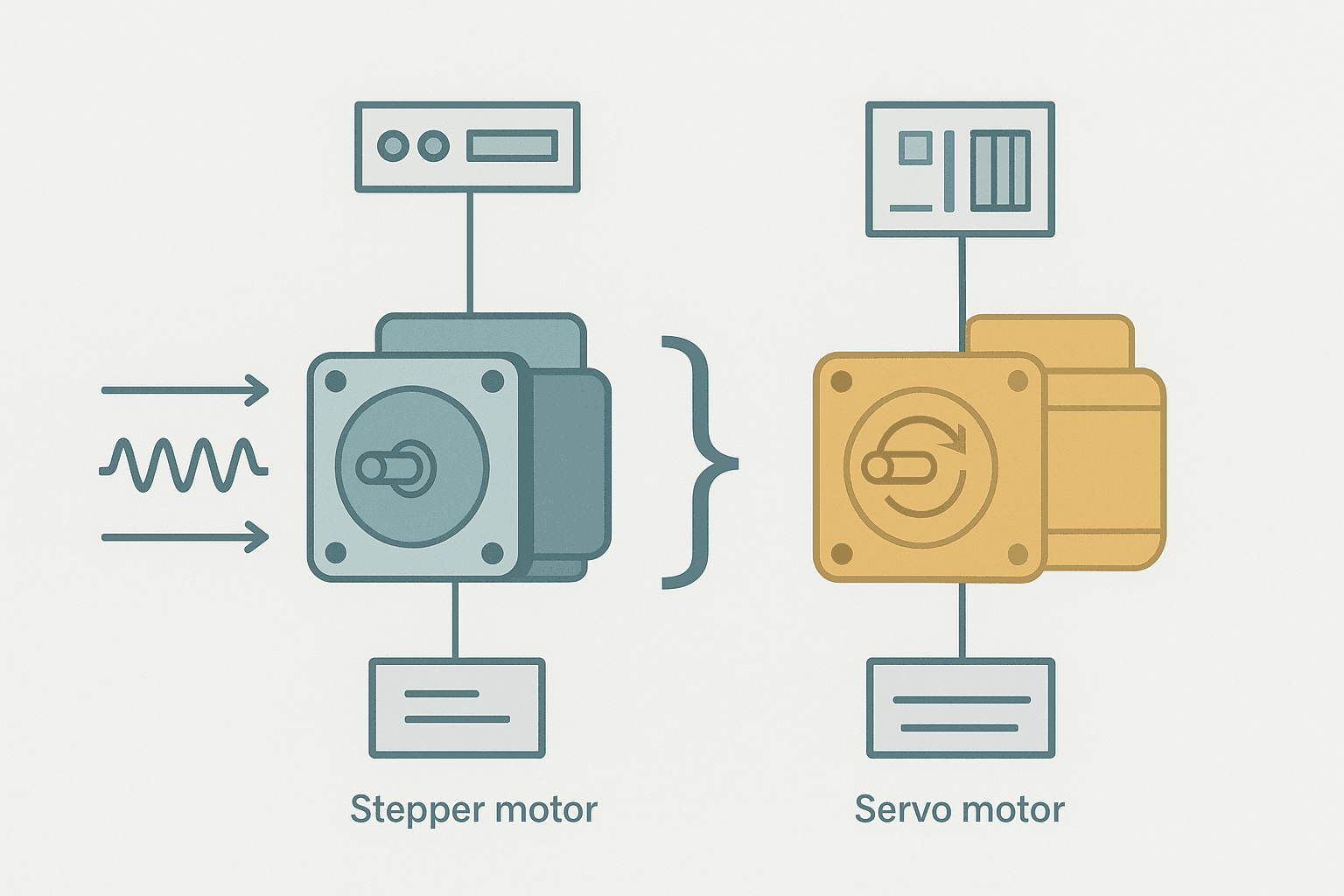
Pick the wrong motor technology and you will spend weeks fighting resonance, losing position, or simply wasting money on a drive system that was overkill for the job. The stepper vs servo motor question comes up on almost every motion project, and the answer is rarely obvious from a datasheet alone. This post gives you the honest tradeoffs, real numbers, and the decision framework I actually use in the field.
How Each Motor Type Actually Works
Stepper Motor Basics
A stepper motor is a brushless DC motor with a high pole count, typically 50 rotor teeth on a 1.8-degree motor, giving 200 full steps per revolution. The drive energises windings in sequence and the rotor clicks to each magnetic detent. There is no position feedback by default. The controller assumes every commanded step was taken. If the load torque exceeds the motor's pull-out torque, the motor stalls and you lose position silently.
Most modern stepper drives use microstepping, dividing each full step into 8, 16, or 32 microsteps. A 1/16 microstepping drive gives 3200 steps per revolution, which sounds precise, but the actual positional accuracy at each microstep is not as good as the math suggests. Expect roughly 5% of full-step error at each microstep position. That is about 0.28 degrees per full step, so the real worst-case error on a 200-step motor running at 1/16 microstepping is still around 0.09 degrees, not 0.006 degrees.
Servo Motor Basics
A servo system is a motor (usually a low-pole-count brushless AC or DC machine) combined with a feedback device and a drive that closes the position, velocity and sometimes torque loop in real time. The drive compares commanded position to measured position every 125 microseconds or faster and adjusts current to minimise the error. If the load pushes the rotor off target, the drive corrects it. That is the fundamental difference: a servo knows where it is; a stepper assumes where it is.
Common feedback devices are incremental encoders (1000 to 65536 lines per revolution), absolute encoders (17-bit or 23-bit are now standard on mid-range servos), and resolvers in high-temperature or high-vibration environments. The Yaskawa Sigma-7 series, Panasonic MINAS A6, Allen-Bradley Kinetix 5300, and Siemens SINAMICS S210 are all examples you will encounter on industrial machines.
Stepper vs Servo Motor: The Key Differences
| Factor | Stepper Motor | Servo Motor |
|---|---|---|
| Position feedback | None (open loop) or optional encoder add-on | Closed loop, always |
| Typical accuracy | Full step: 1.8 deg, Microstep: ~0.1 deg (with error) | 0.01 deg or better depending on encoder |
| Peak torque vs rated | Rated torque IS near-peak torque | Peak torque 2x to 5x rated (short duration) |
| Torque at speed | Drops sharply above 500 to 1000 RPM | Flat to rated speed (2000 to 6000 RPM typical) |
| Resonance risk | Yes, especially 100 to 300 RPM range | No, drive actively damps oscillation |
| Heat at standstill | Full current always (unless drive reduces it) | Near-zero current if at rest under no load |
| Drive cost (typical) | $50 to $300 for drive + motor | $300 to $2000+ for drive + motor |
| Wiring complexity | Step + Direction signals, 4 wires to motor | Encoder cable + power cable + drive comms |
| Sizing headroom needed | 2x to 3x your peak load torque | 1.2x to 1.5x is often enough |
| Stall detection | No (unless you add encoder) | Yes, drive faults on following error |
The Torque Curve Is the Most Important Difference
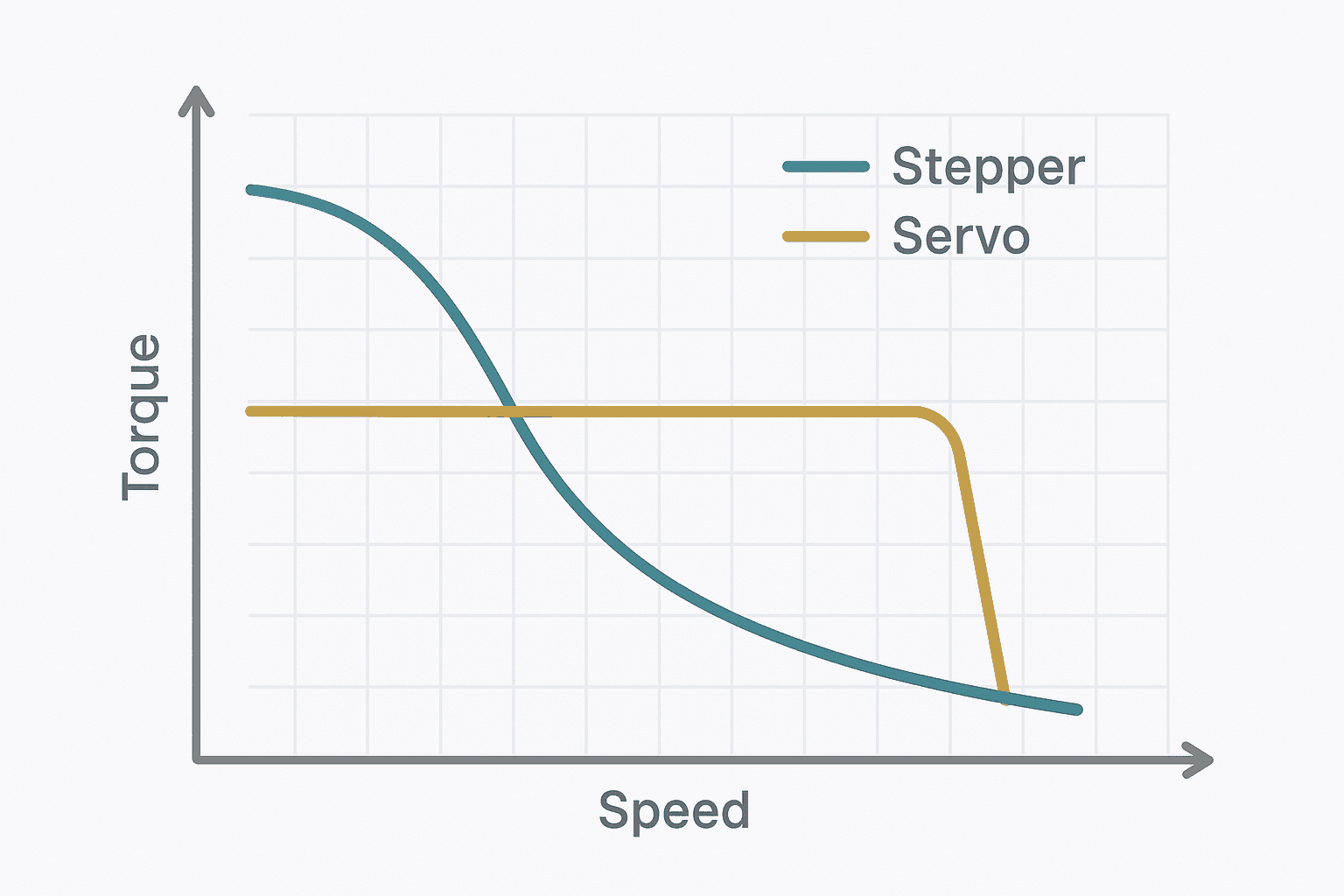
If you only take one thing from this post, make it this: a stepper's torque drops dramatically with speed, while a servo's torque stays flat up to the rated speed. A typical NEMA 23 stepper (0.9 Nm holding torque) might deliver 0.9 Nm at 100 RPM but only 0.3 Nm at 600 RPM and almost nothing useful at 1200 RPM. A servo motor rated at 0.9 Nm will deliver that all the way to 3000 RPM.
This is why steppers work well for slow, precise positioning (label applicators, syringe pumps, 3-D printers) and why they fall apart on high-speed pick-and-place or CNC routing where you need torque at 2000 RPM and above.
Holding Torque: Where Steppers Shine
Steppers have genuine detent torque even with the drive de-energised (typically 10 to 20% of rated holding torque just from the magnetic detents). With the drive energised and motor stationary, they deliver full rated holding torque continuously. That makes them excellent for applications like vertical axes that must hold position without a brake, or clamping mechanisms that need to stay put under load.
A servo at standstill uses very little current and can be back-driven by hand if the drive is off. If you have a vertical load on a servo axis, you need a brake. Many servo motors include an optional 24 VDC holding brake for exactly this reason, but it adds cost and a brake release delay you must account for in your motion profile.
When a Stepper Is the Right Call
- Low speeds (under 500 RPM) with predictable, bounded load torque
- Positioning accuracy requirements of 0.1 to 1 degree or worse
- Budget is tight and cycle times allow for it
- Simple step-and-direction interface to a PLC or motion controller without complex tuning
- High pole count means fine positioning without expensive feedback (label printers, fluid dispensing, simple XY gantries)
- Dozens of axes on a machine where servo cost would be prohibitive (pick-and-place palletisers with many low-load axes)
When a Servo Is the Right Call
- Speeds above 500 to 1000 RPM with any significant load
- Tight following-error requirements (CNC, robotics, web tension control)
- Highly variable or unknown loads where the closed-loop corrects in real time
- Multi-axis coordinated motion (electronic gearing, cam profiles, flying shears)
- High duty cycle applications where stepper heating would be a problem
- Safety-critical axes where a missed step must trigger a fault, not silently continue
Connecting Either to a PLC: Step-Direction vs Network Motion
Most stepper drives accept Step and Direction pulse signals, which any PLC with a high-speed output (HSO) can generate. On a Siemens S7-1200 or 1500, the built-in PWM/pulse outputs handle this natively through the Motion Control technology objects. On Allen-Bradley, a Kinetix 300 servo drive accepts step-direction from a Micro820 or Micro850 PLC the same way a stepper drive would.
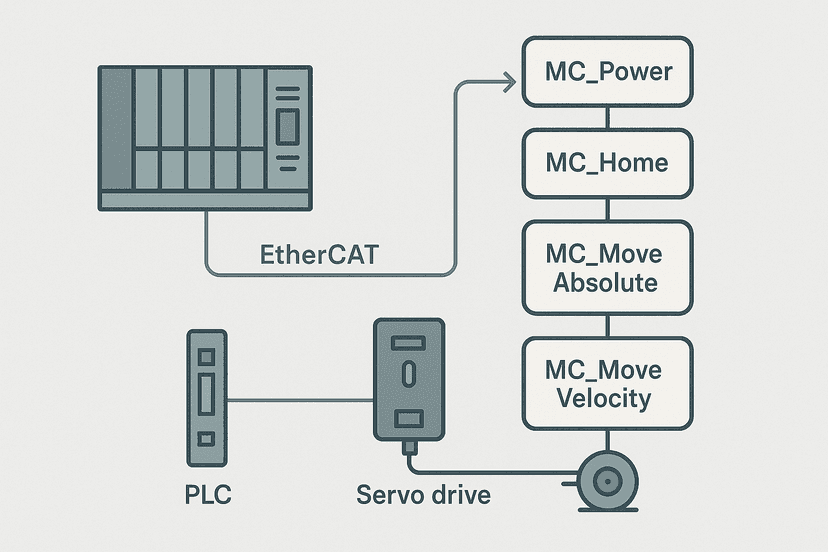
For more demanding servo systems, the drive communicates over an industrial network: EtherCAT (Beckhoff TwinCAT, Omron Sysmac), PROFINET with PROFIdrive profile (Siemens SINAMICS), EtherNet/IP with CIP Motion (Allen-Bradley Kinetix 5500, 5700), or MECHATROLINK-III (Yaskawa). These network-based systems give you position, velocity, and torque control from the PLC at 250 to 1000 microsecond update rates, plus full diagnostics.
Cost Reality Check
A NEMA 23 stepper with a decent microstepping drive (such as a Gecko G213V or a DM542T) costs $60 to $150 all-in. A comparable servo system (0.4 kW, absolute encoder, EtherCAT drive) runs $400 to $800 for the motor alone and another $300 to $600 for the drive, plus the feedback cable which can be $80 to $150 depending on length and shielding. The wiring, tuning time, and commissioning overhead also increase.
On a 40-axis machine, that cost difference is real money. On a single-axis precision application where a mis-positioned part costs you a $500 part rejection, the servo pays for itself in one shift. Know your application before you open a catalogue.
The Resonance Problem Nobody Talks About Enough
Steppers have a natural resonance frequency, typically in the 100 to 200 RPM range for common NEMA 23 and 34 motors. Run through that speed band too slowly and the motor vibrates badly, loses torque, and can stall. Most drives include anti-resonance or mid-band compensation filters, and they help significantly. But if your application requires slow, smooth motion through that resonance band (like a camera slider or a telescope mount), a servo is genuinely smoother.
Servos have their own tuning challenges. A poorly tuned velocity loop will oscillate or hunt, especially with a light load on a stiff mechanical coupling. But the tuning tools in modern drives (auto-tuning in Yaskawa Sigma-7, one-button tuning in Panasonic A6) have made this much less painful than it was 10 years ago.
Quick Decision Guide
- Is your max speed under 500 RPM and load torque predictable? Stepper is likely fine.
- Do you need to know immediately if position is lost? Add encoder feedback or go servo.
- Is cycle time tight and speed above 1000 RPM? Go servo.
- Are you running more than 8 to 10 axes at low load? Stepper on each axis keeps cost manageable.
- Is the axis vertical, holding a load? Stepper with energised drive, or servo with a brake.
- Is this a safety-relevant axis (pinching, crushing risk)? Servo with following-error fault, reviewed against your IEC 62061 SIL requirements.
There is no single winner. The engineers who argue that servos are always better have not priced a 48-axis dispenser machine. The engineers who default to steppers on everything eventually get a stall-induced product defect and a very uncomfortable conversation with their customer. Pick the technology that fits the physics and the budget of the specific axis.
Frequently asked questions
Is a stepper motor more accurate than a servo?
Which has better holding torque, stepper or servo?
Can I use a stepper motor for CNC routing?
Do servo motors require more wiring than steppers?
What is the difference between a closed-loop stepper and a true servo?
Which is better for a robot arm, stepper or servo?
Learn this by building it
There is a PLC in this site. It runs a real scan engine, checks your logic against the same tests a working machine would fail, and needs no download and no account.
Open the exercisesFree, no signup, runs in your browser. See all 16 exercises.
Was this helpful?