SCADA Communication Protocols: Modbus, DNP3 and OPC UA
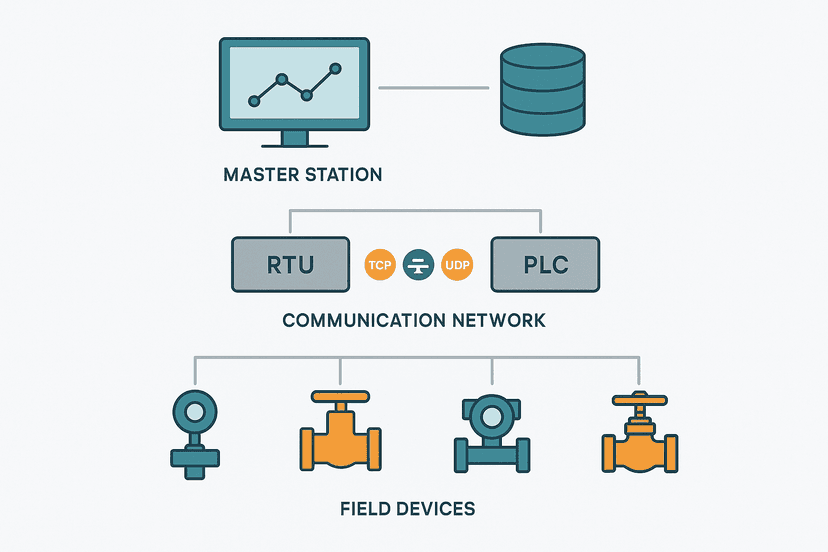
Every SCADA project eventually asks the same question: how does data actually get from the field device to the master station? Three protocols dominate that conversation: Modbus, DNP3 and OPC UA. Each one was built for a different era and a different problem, and picking the wrong one wastes commissioning time fast. This post breaks down what each protocol actually does, where it belongs, and the practical gotchas you'll hit before you finish the job.
SCADA Communication Protocols: Why One Size Never Fits All
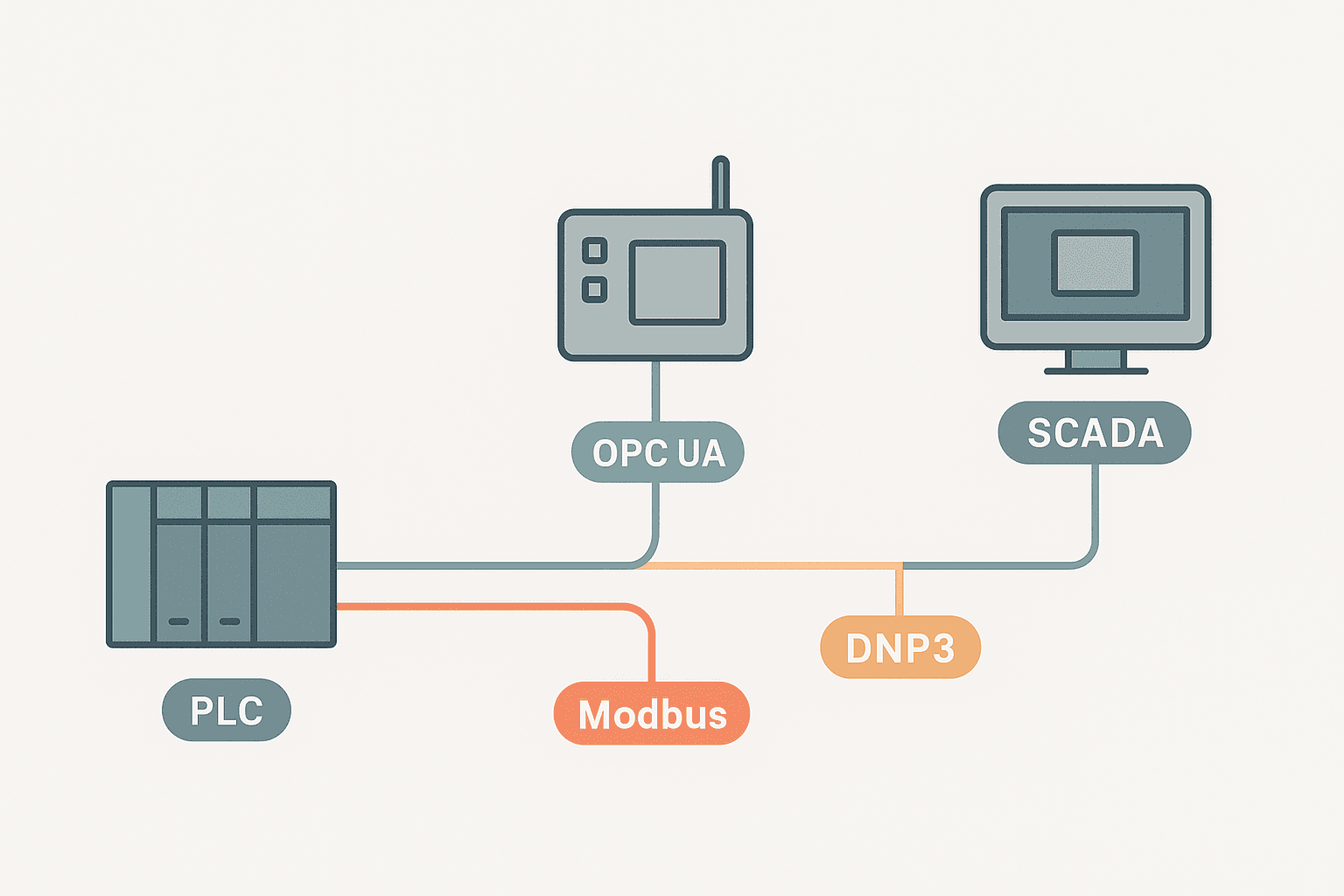
SCADA systems talk to a huge range of field hardware: PLCs, RTUs, meters, analyzers, protection relays. Some of that hardware was installed in the 1990s and will outlast most of us. Some of it was commissioned last month and ships with a built-in OPC UA server. The protocol stack has to span both worlds, and that is exactly why Modbus, DNP3 and OPC UA all still coexist on the same plant network. Understanding their origins helps you predict their limits.
Modbus: Simple, Everywhere, and Showing Its Age
Modbus was published by Modicon in 1979. It is a master-slave, request-response protocol with almost no overhead. The master polls a device, the device answers, done. There is no unsolicited reporting, no built-in security, no timestamps, no data typing beyond 16-bit registers and coils. That simplicity is both its greatest strength and its biggest limitation.
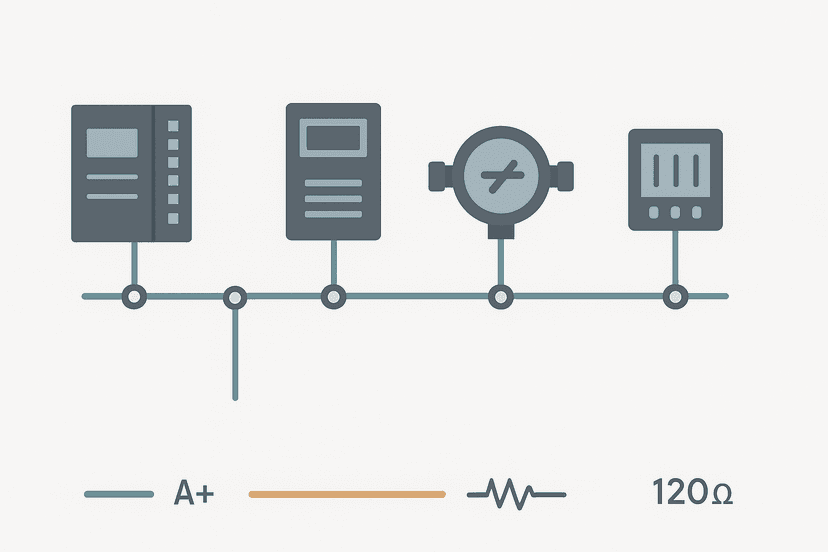
In SCADA contexts you will see two flavors. Modbus RTU runs over RS-232 or RS-485 serial at speeds typically between 9600 and 115200 baud. Modbus TCP wraps the same PDU (protocol data unit) in a TCP/IP packet on port 502. The register model is identical: you read holding registers (function code 03), input registers (FC 04), coils (FC 01) or discrete inputs (FC 02). If you want a deeper look at the RTU frame structure and timing, the post Modbus RTU Protocol Explained: Frames, Timing and Wiring covers that in detail.
Modbus TCP is still the right choice for short-range, high-refresh-rate polling on a local Ethernet segment: a SCADA server talking to 20 PLCs in the same building, for example. Scan cycles of 100 to 500 ms per device are easy to achieve. But if you need time-stamped events, exception-based reporting, or any kind of security, Modbus cannot help you. You need DNP3 or OPC UA. If you want to decode Modbus registers quickly, the Modbus register calculator on this site handles byte/word order and data type decoding.
DNP3: Built for the Utility World
DNP3 (Distributed Network Protocol 3) was developed in the early 1990s specifically for SCADA in electric utilities and water/wastewater systems. The IEEE ratified it as IEEE 1815 in 2010. It solves the exact problems Modbus ignores: unreliable serial links over long distances, the need for time-stamped events, and unsolicited reporting so you are not burning bandwidth polling devices that have nothing new to say.
Key DNP3 Concepts You Need to Know
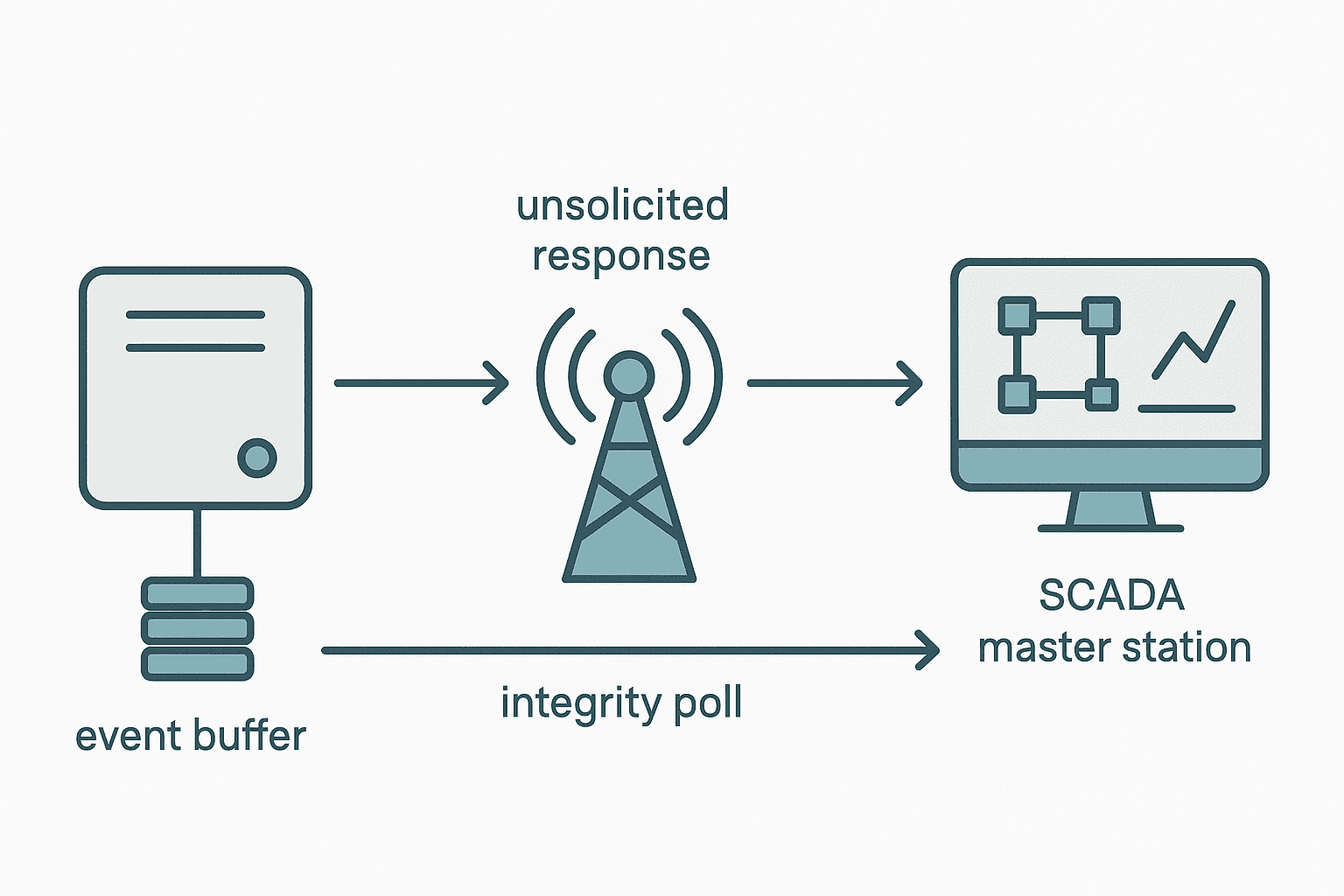
- Unsolicited responses: an RTU can push data to the master when a value changes, rather than waiting to be polled. On a slow radio link this is a major bandwidth saving.
- Event buffering: DNP3 outstation devices buffer events with millisecond timestamps in their own memory. If the comms link drops for 10 minutes and then recovers, the master can request the event log and reconstruct exactly what happened and when.
- Data object model: DNP3 defines typed objects (analog inputs, binary inputs, counters, analog outputs, binary outputs) with built-in quality flags (online, restart, communications lost, remote forced). You always know the quality of a value, not just its magnitude.
- Integrity polls vs event polls: the master periodically does a full integrity poll to sync state. Between polls it only requests events. This is far more efficient than constant full polls.
- Secure Authentication (SA): DNP3 Secure Authentication v5 (SAv5) adds challenge-response HMAC-based authentication. In ICS security frameworks this matters for critical infrastructure.
DNP3 runs over serial (RS-232/485) or TCP (typically port 20000). The serial version was designed to work reliably over noisy radio links at 1200 to 9600 baud, which is why it has a strong CRC on every data link layer frame. If you are integrating a substation IED (intelligent electronic device), a remote pump station RTU, or a water tower level controller that phones in over cellular, DNP3 is almost certainly the right protocol.
OPC UA: The Modern Standard for SCADA Integration
OPC UA (OPC Unified Architecture) is a completely different beast. The OPC Foundation published the first spec in 2006, and it is now the preferred protocol for any new SCADA project that talks to modern PLCs, DCS, MES or cloud systems. It is not a simple polling protocol. It is a full service-oriented architecture with a structured information model, built-in security, and a publish-subscribe mechanism on top of the traditional client-server model.
What OPC UA Actually Gives You
- Self-describing information model: an OPC UA server exposes a node hierarchy. A SCADA client can browse the server and discover what data exists without a separate engineering document. This is a huge deal for integration.
- Subscriptions and monitored items: the client subscribes to specific nodes at a defined sampling interval. The server only sends data when a value changes by more than a configurable deadband. Far more efficient than polling every register.
- Built-in security: OPC UA has mandatory transport encryption (TLS 1.2 or higher on port 4840 by default), message signing, and certificate-based authentication. This is not an optional add-on; it is part of the spec.
- Rich data types: OPC UA supports integers, floats, strings, arrays, structures, enumerations and complex custom types. No more cramming a float into two 16-bit registers and hoping the byte order matches.
- Platform independence: OPC UA runs on Windows, Linux, embedded RTOS, and even bare-metal microcontrollers. Siemens S7-1500, Beckhoff TwinCAT, Phoenix Contact PLCnext and Omron NX all ship with native OPC UA servers.
- OPC UA PubSub: the publish-subscribe extension (Part 14 of the spec) sends data over MQTT or UDP without a persistent connection. This is the path to cloud and IIoT integration.
The tradeoff is complexity. Configuring certificates, setting up a UA server namespace, and mapping PLC tags to UA nodes takes more engineering time than dropping in a Modbus TCP driver. On a tight retrofit budget with 50 legacy PLCs that already have Modbus TCP, ripping everything out for OPC UA is not always justified. But for any greenfield project in 2024 and beyond, OPC UA should be your default choice for SCADA-to-PLC communication.
BadSecurityChecksFailed error. Always add the client certificate to the server's trusted store and vice versa before you start testing connectivity.Side-by-Side Comparison: Modbus vs DNP3 vs OPC UA
| Feature | Modbus RTU/TCP | DNP3 | OPC UA |
|---|---|---|---|
| Origin | 1979, Modicon | 1993, GE Harris / IEEE 1815 | 2006, OPC Foundation |
| Transport | RS-485 / TCP port 502 | RS-232/485 / TCP port 20000 | TCP port 4840 (default) |
| Topology | Master-slave only | Master-outstation (+ peer-to-peer in some implementations) | Client-server + PubSub |
| Unsolicited reporting | No | Yes (native) | Yes (subscriptions) |
| Event timestamping | No | Yes, millisecond resolution | Yes, UTC timestamps on nodes |
| Data quality flags | No | Yes (online, comms lost, etc.) | Yes (StatusCode on every value) |
| Built-in security | None | SAv5 (HMAC auth) | TLS encryption + certificates (mandatory) |
| Self-describing | No (external register map) | Partial (DPD document) | Yes (browsable information model) |
| Typical use case | Local PLC polling, retrofit | Utility RTUs, remote sites, radio links | Greenfield SCADA, MES, cloud, IIoT |
| Setup complexity | Low | Medium | Medium to high |
How to Choose: A Practical Decision Framework
In practice, most large SCADA systems run all three protocols at the same time. Here is how to think about it:
- Retrofit or legacy device with no serial port documentation: Modbus RTU or TCP is almost certainly already there. Use it, document the register map, and move on.
- Remote site on a cellular or radio link with unreliable connectivity: DNP3. The event buffering alone is worth the configuration effort. You will not lose data during link outages.
- Electric utility substation or water utility SCADA: DNP3 is the industry standard. Your integrators, RTU vendors and SCADA software will all expect it.
- New PLC or controller with a built-in OPC UA server: use it. The browsable namespace replaces manual register mapping and the security is far better than leaving Modbus TCP wide open.
- Connecting SCADA to MES, ERP or a cloud historian: OPC UA PubSub over MQTT is the cleanest path. It is what the ISA-95 and Industry 4.0 world is converging on.
- Very high poll rates, sub-100 ms, on a local LAN: Modbus TCP or OPC UA subscriptions with a short publishing interval both work. OPC UA with a 50 ms monitored item interval is entirely feasible on a modern PLC.
Security Considerations You Cannot Ignore
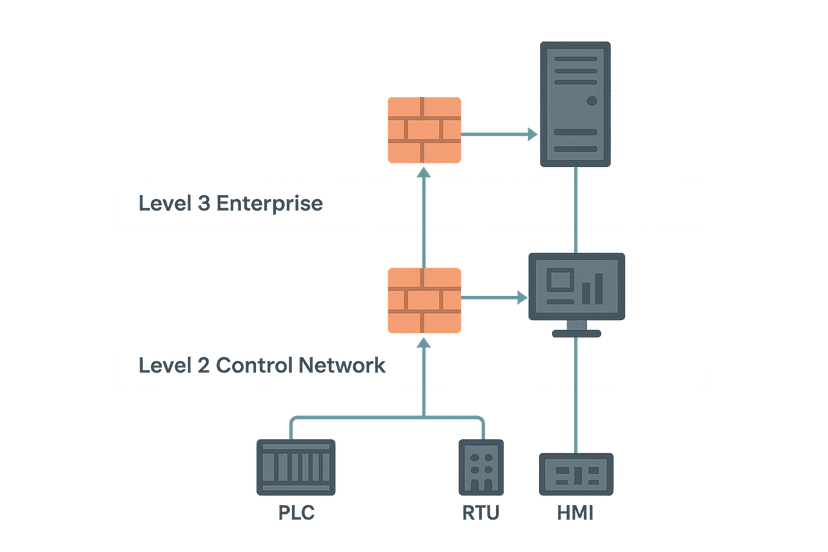
Modbus has zero authentication. Any device on the network can write to any register. If your SCADA Modbus TCP traffic is on a flat, unprotected network, a compromised engineering workstation can command field devices directly. This is a known attack vector documented by ICS-CERT. At minimum, segment Modbus traffic behind a firewall and restrict TCP port 502 to known source addresses.
DNP3 SAv5 adds authentication but it is still an optional configuration in most RTUs. Many installed DNP3 systems run without it. If your SCADA system qualifies as critical infrastructure under NERC CIP or IEC 62443, verify authentication is actually enabled on every outstation.
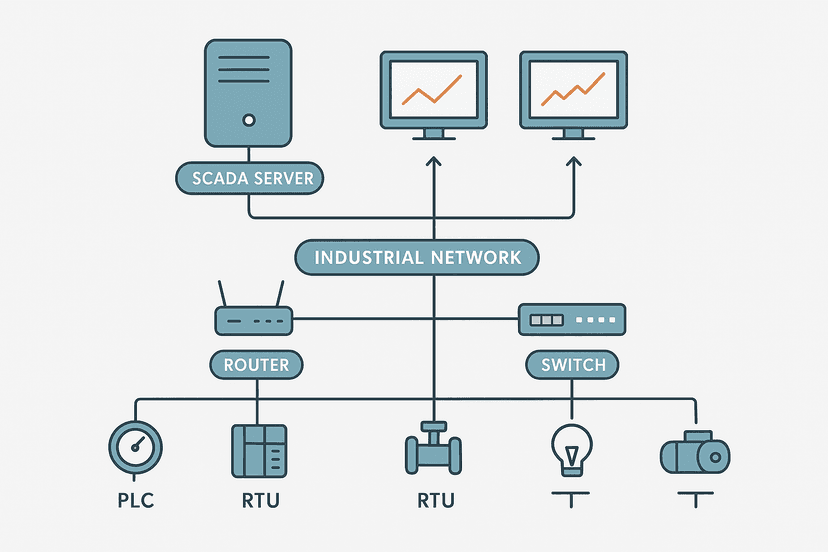
OPC UA with Security Mode set to None is just as vulnerable as Modbus. Always configure SignAndEncrypt mode in production. The extra certificate management overhead is a one-time cost. For a broader look at how these protocols fit into the network layer of a SCADA architecture, the post SCADA Network Design: Topologies, Protocols and Security covers network segmentation and firewall strategy in detail.
Real-World Coexistence: One Project, Three Protocols
A municipal water treatment plant I worked on ran all three simultaneously. The legacy chemical dosing controllers from 2003 spoke Modbus RTU over RS-485. The remote pump stations at the reservoirs, connected over 4G cellular, used DNP3 TCP with event buffering and 15-minute integrity polls. The new S7-1500 PLCs in the main treatment building had native OPC UA servers and fed data directly into the Ignition SCADA historian over OPC UA subscriptions at 1 second intervals. The SCADA software (most modern platforms including Ignition, Wonderware and AVEVA) handled all three drivers natively. You rarely get to standardize on one protocol across a whole site, and that is fine. Know what each one is good at and use it accordingly.
If you are still getting your bearings on where these protocols sit in the bigger picture, What Is a SCADA System and How Does It Work? is a good place to anchor the architecture before going deep on any single protocol.
Frequently asked questions
Can Modbus TCP and OPC UA run on the same PLC at the same time?
What is the main advantage of DNP3 over Modbus for remote sites?
Is OPC UA replacing Modbus and DNP3 in new SCADA projects?
What port does OPC UA use and does it need firewall exceptions?
Does DNP3 work over Ethernet or only serial?
How do I handle Modbus register byte order when floating point values look wrong?
Learn this by building it
There is a PLC in this site. It runs a real scan engine, checks your logic against the same tests a working machine would fail, and needs no download and no account.
Open the exercisesFree, no signup, runs in your browser. See all 16 exercises.
Was this helpful?