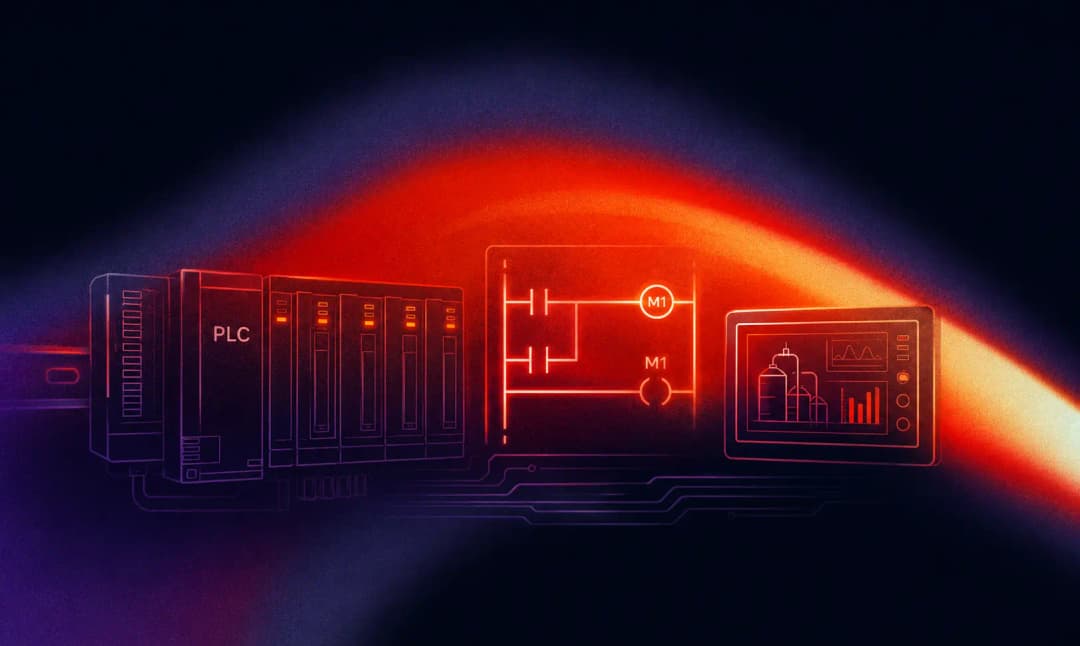
📢 Fresh Content: PLC Troubleshooting Tips That Work Across Any Platform | Click to read on PLCDocs!
About
Learn automation by building it
PLC Programming Blog is a free set of tools and tutorials for people learning industrial automation: a ladder logic simulator that runs in your browser, exercises that check themselves, and the calculators controls engineers reach for every week.
A ladder logic simulator that actually runs
Build a rung in the browser and watch power flow through it, scan by scan, the way a controller solves it: contacts, coils, latches, timers, counters, compares, math, and routines called with JSR. There is a free-build sandbox and graded exercises.
Open the practice exercises →Exercises that check themselves
16 exercises, beginner to senior, each on a pattern you will meet in the field: start/stop seal-ins, set/reset latches, one-shots, on and off delays, retentive timers, counters, step sequences and a full star-delta starter. Each one drives your program and tells you exactly which check failed.
See how it works →Calculators for the everyday jobs
Analog scaling, Modbus register addressing, wire and cable sizing, IP subnetting, PID tuning and a structured text formatter. All of them run in your browser, with nothing sent anywhere.
Browse the tools →A learning path and a glossary
If you are starting from nothing, the learning path puts the ground work in order: electrical basics, schematics, components, sensors, PLCs, HMI and networking. The glossary explains the words the rest of the industry assumes you already know.
Follow the learning path →How we build it
No account, ever
Nothing here asks you to sign up. Your programs and your progress live in your own browser, and a shared program travels inside its own link rather than sitting on a server of ours.
Free, and not a trial
Every tool and every exercise is complete. There is no locked tier and no export that quietly costs money.
Correct before clever
The simulator follows real controller behaviour: rungs solve top to bottom, a timer resets when its rung goes false, counters count on the edge. If it runs here, it will make sense on a real PLC.
Written by people who have commissioned panels
The exercises are the patterns that come up on real machines, in the order they usually come up.
Something missing, or something broken?
Get in touch →