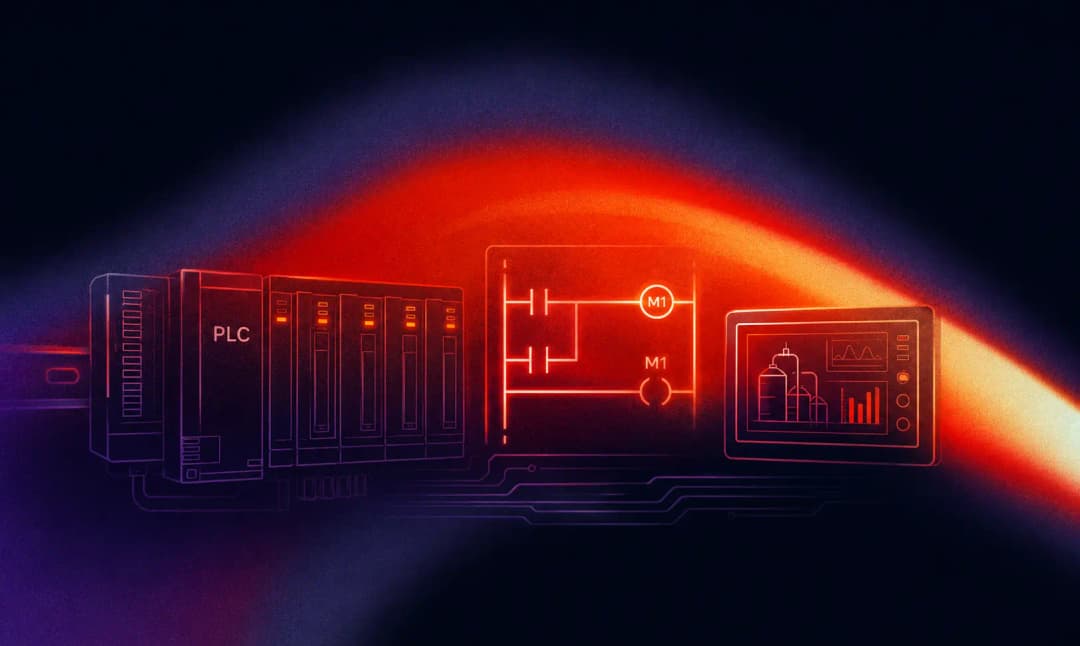
📢 Fresh Content: PLC Troubleshooting Tips That Work Across Any Platform | Click to read on PLCDocs!
PLC · Controls Foundations
PLC & Automation Glossary
Every term a beginner needs, defined in plain English. Working through the field? Follow the learning path alongside it.
Showing 59 of 59 terms
Actuator
Device that produces motion or action from a signal.
Alarm
A notification that something is abnormal.
Analog signal
Continuous value, e.g. 4-20 mA or 0-10 V.
As-built
Final documentation reflecting what was actually installed.
Circuit breaker
Protective device that trips on overcurrent or short circuit.
Coil
Output element that is energised by a rung.
Commissioning
Bringing a machine online and proving it works.
Contact (NO/NC)
Switch element in logic: normally-open or normally-closed.
Contactor
Heavy-duty relay for switching motors and large loads.
Control panel / cabinet
Enclosure that houses the control equipment.
Counter
Instruction that counts events.
Digital signal
On/off (1/0) signal.
DIN rail
Standard metal rail that components clip onto.
Emergency stop
Hardwired stop that removes power safely.
Fault
A failure or abnormal state.
Field device
Any sensor or actuator out on the machine.
Fieldbus
Industrial network connecting field devices.
Fuse
Sacrificial overcurrent protection element.
Gateway
Device that translates between two protocols.
Grounding / earthing
Safety connection to earth potential.
Historian
Database that logs process values over time.
HMI
The operator's touchscreen interface.
Indicator / pilot light
Status light on the panel front.
Input
Signal coming into the PLC from the field.
Interlock
A condition that must be met before an action is allowed.
Ladder logic
The most common PLC language, drawn as rungs like a ladder.
Limit switch
Mechanical switch triggered when movement reaches a position.
Modbus
Simple, widely-used industrial protocol.
Motor
Converts electrical energy into rotation.
Output
Signal the PLC sends out to actuators.
Overload relay
Protects a motor from drawing too much current.
Photoelectric sensor
Detects objects using a light beam.
PLC
Industrial computer that runs the machine's control logic.
Pneumatic cylinder
Air-driven actuator that pushes or pulls.
PNP / NPN
Sensor output wiring types: sourcing or sinking.
Power supply
Converts AC mains to DC (usually 24 V).
Proximity sensor
Detects an object without touching it.
Push button
Operator button: start, stop, reset.
Register
A 16-bit memory location in Modbus.
Relay
Electrically-operated switch for small loads and isolation.
Rung
One horizontal line of ladder logic.
Safety relay
Monitors safety devices (E-stop, guards) to a rated level.
SCADA
Supervisory system that monitors and controls many machines.
Scan cycle
PLC repeatedly reads inputs, solves logic, writes outputs.
Seal-in / latch
A rung that keeps itself energised after the button is released.
Selector switch
Multi-position operator switch, e.g. auto/manual.
Sensor
Detects a condition in the field: presence, level, position.
Sequence of operations
Written description of how the machine runs its cycle.
Setpoint
The target value the system aims for.
Single-phase
Single AC supply, common for control and small loads.
Sinking / sourcing
The direction current flows at a digital I/O point.
Solenoid valve
Electrically-actuated valve for air or fluid.
Tag / address
The name or location of a signal in PLC memory.
Terminal block
Where wires are connected and landed in the panel.
Three-phase
Three-conductor AC power for industrial motors.
Timer
Instruction that delays or times an action.
VFD / inverter
Controls motor speed by varying the supply frequency.
Wire / cable
Conductor carrying current or signals.
Wiring diagram / schematic
Drawing that shows how the panel and machine are wired.