PLC vs DCS: Key Differences and How to Choose
If you have been asked to specify a control system for a new plant, or you are inheriting a brownfield project and wondering whether to upgrade the existing platform, the PLC vs DCS question comes up fast. Both control processes. Both handle analog signals, PID loops and communication networks. Yet they were built from completely different assumptions about what a control system needs to do, and picking the wrong one costs real money.
What Is the Difference Between a PLC and a DCS?
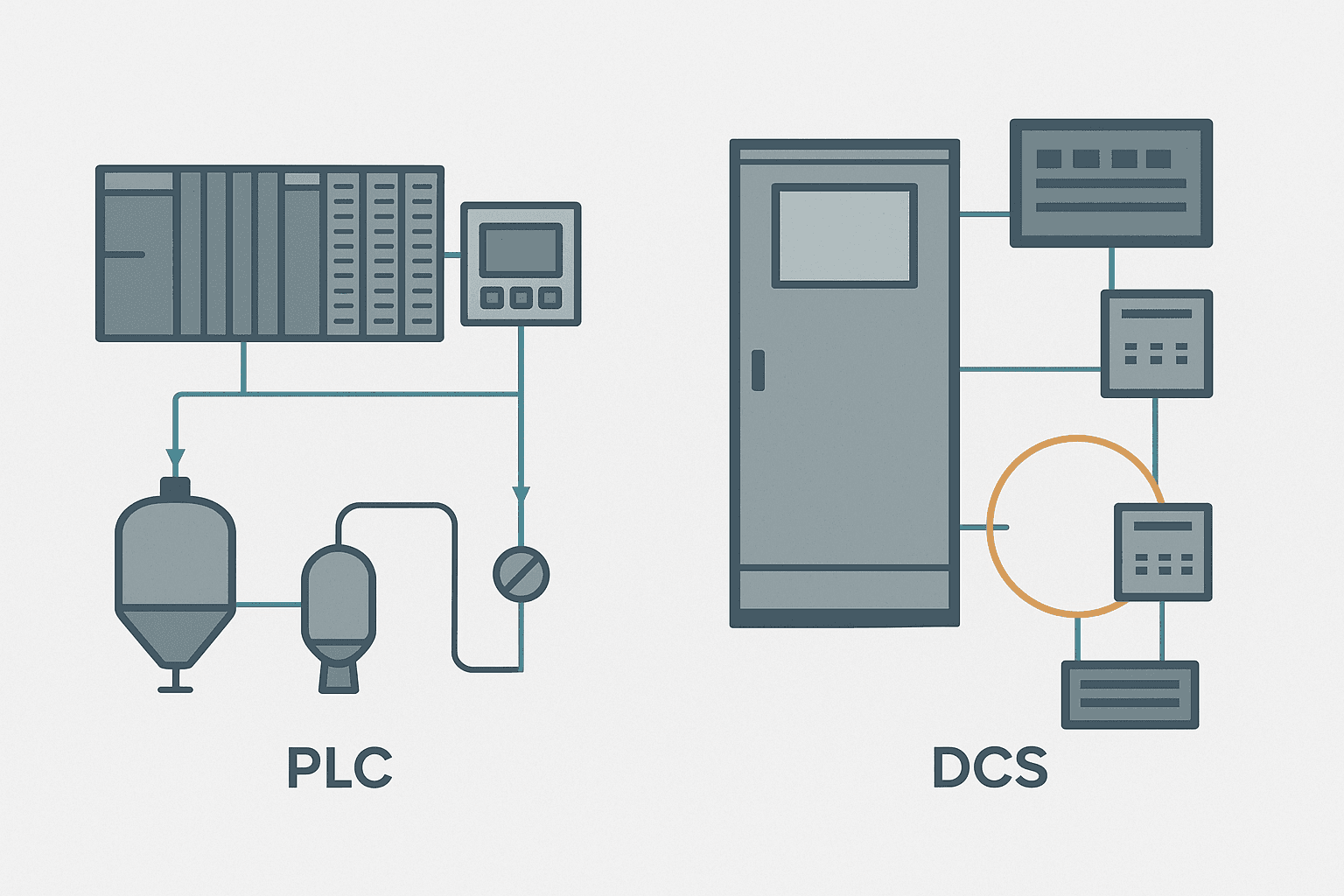
A PLC (Programmable Logic Controller) is a dedicated industrial computer that executes a cyclic scan: it reads all inputs, runs your program, then writes all outputs, repeating this loop every 1 to 20 ms. It was designed for discrete machine control, is programmed in standardized languages defined by IEC 61131-3, and scales well from a single machine to a production line. A DCS (Distributed Control System) is a plant-wide architecture where control is distributed across multiple field controllers that communicate over a proprietary or open fieldbus. The controllers, operator workstations, historian and alarm system are all sold and configured as one integrated product. DCS was designed for continuous process control where a process upset is expensive and availability requirements are near 100%.
Architecture: Where the Two Systems Actually Differ
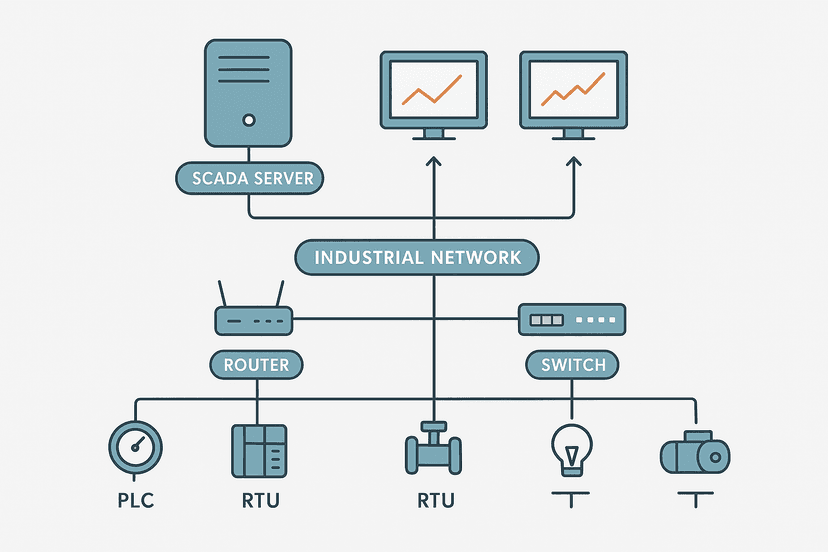
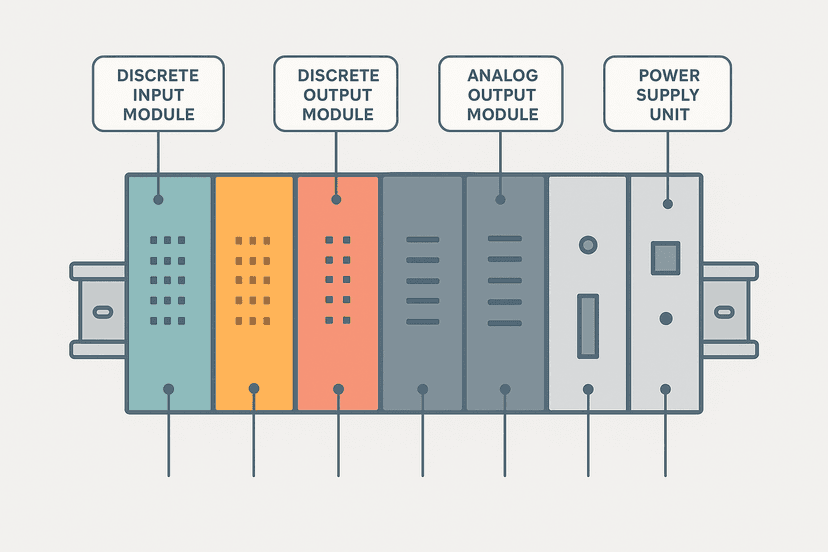
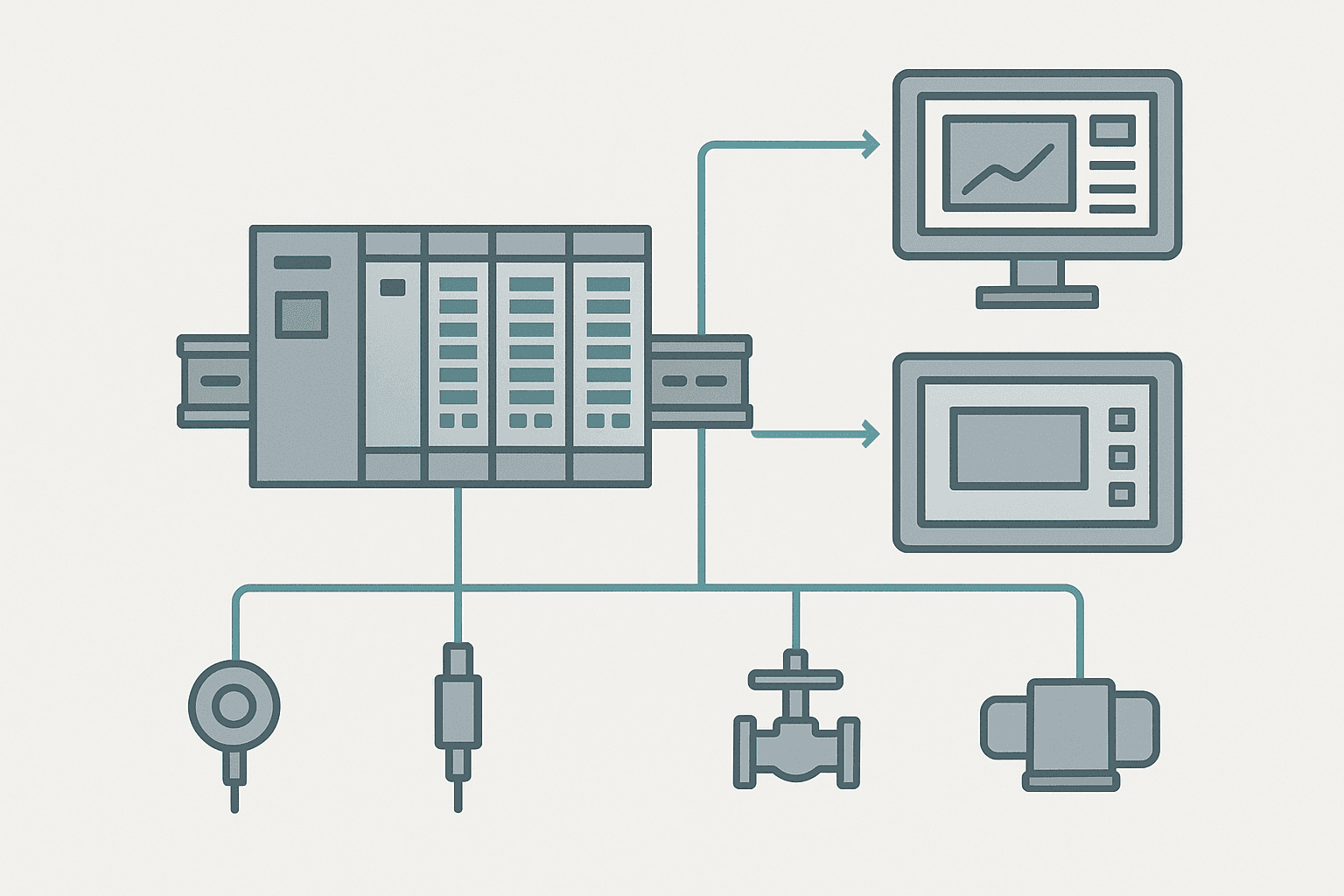
A PLC system is typically centralized at the machine or skid level. You have one CPU (or a small cluster), local I/O modules in a rack, and a separate SCADA or HMI layer on top. The PLC does not care about the operator station: it runs its scan whether the HMI is connected or not. If you want redundancy, you specify a redundant CPU module separately and configure it. If you want a historian, you buy a SCADA historian add-on. Everything is assembled from parts.
A DCS flips this. The system is sold as a complete solution. Field controllers, engineering workstations, operator consoles and the historian all speak a common internal protocol, usually proprietary. Yokogawa CENTUM VP, Emerson DeltaV, Honeywell Experion and ABB Ability System 800xA all follow this model. Redundancy is a checkbox in the configuration tool, not an afterthought. The engineering environment manages I/O, loops, alarms and operator graphics in one place. That integration is what you are paying for.
Scan Time and Control Performance
Scan time is where PLC systems have a clear edge for machine control. A Siemens S7-1500 or Allen-Bradley CompactLogix running a typical discrete program will scan in under 5 ms. Some motion-focused PLCs execute tasks at 250 microseconds or less. DCS controllers target regulatory control loop execution of 100 to 500 ms because continuous process loops (flow, temperature, pressure) simply do not need faster updates and the overhead of coordinating thousands of I/O points across a distributed network adds latency.
This matters a lot in certain applications. A bottling line, a servo-driven cutting machine, or an injection moulding press needs sub-10 ms response to position sensors and actuators. A crude distillation column running at steady state is perfectly happy with a 500 ms loop update. Putting a DCS on a high-speed packaging machine is overkill and often creates problems. Putting a PLC on a 200-loop refinery unit works, but you will spend significant engineering time building what a DCS gives you out of the box.
I/O Count, Redundancy and Availability
Here is a rough rule of thumb from the industry: under 2,000 I/O points, a PLC system almost always wins on cost and simplicity. Above 5,000 I/O points across a continuous process, a DCS starts making economic sense because the integration overhead on a PLC-plus-SCADA system grows faster than the DCS premium. Between 2,000 and 5,000 points you need to evaluate the specific process type, redundancy requirements and available engineering skills.
| Factor | PLC System | DCS |
|---|---|---|
| Typical scan time | 1 to 20 ms | 100 to 500 ms |
| I/O sweet spot | Up to 2,000 points | 2,000 to 100,000+ points |
| Redundancy | Available, configured separately | Built-in, standard option |
| PID loops | Dozens to hundreds (function blocks) | Thousands (native, tuning tools included) |
| Operator interface | Separate HMI or SCADA layer | Integrated operator workstations |
| Typical hardware cost per I/O | Lower (often 2x to 5x less) | Higher, but bundled engineering tools |
Engineering, Programming and Maintenance
PLC programming follows IEC 61131-3, which means your team can move between ladder logic, structured text and function block diagrams on platforms from Siemens, Rockwell, Omron and most others. The 5 types of PLC programming languages are standardized enough that a competent PLC programmer can pick up a new vendor's IDE in a week. That portability is genuinely valuable for maintenance staffing.
DCS programming is more proprietary. Emerson DeltaV uses Control Studio with function block diagrams. Honeywell Experion has its own Control Builder. Yokogawa CENTUM uses a graphical scheme editor. Each system has its own certification path, its own consultant pool and its own licensing model. Once you commit to a DCS vendor, switching is a plant-shutdown project. I have seen plants trapped on a 20-year-old DCS because the cost to migrate was higher than the cost to keep patching the old system.
Where PLC Systems Win
- Discrete and machine control: packaging, assembly, conveyors, press lines, anything needing fast scan times and tight motion coordination.
- Smaller continuous processes: skid-mounted units, pump stations, compressor packages, small batch processes under 1,000 I/O.
- Budget-constrained projects: PLC hardware is cheaper per point, and open SCADA software gives you a good operator interface at reasonable cost. Check out what SCADA software features to look for when building a PLC-plus-SCADA stack.
- Mixed discrete and analog: a food and beverage line with conveyors, filling stations and some temperature loops is a natural PLC application.
- Projects requiring portable skills: your maintenance team knows Studio 5000 or TIA Portal, so staying on that platform reduces long-term risk.
Where DCS Systems Win
- Large continuous processes: refineries, chemical plants, power stations with hundreds to thousands of regulatory control loops.
- High-availability requirements: hot-standby redundancy is standard, not an add-on, and failover is transparent to the operator.
- Integrated alarm management: DCS platforms have built-in alarm rationalization and suppression tools. Recreating this on a SCADA layer takes real effort. See how SCADA alarm management works for what you would need to replicate.
- Regulatory compliance environments: pharmaceutical and food plants under FDA 21 CFR Part 11 often prefer DCS because audit trails, electronic signatures and batch records are native features.
- Plants where the operator interface is safety-critical: DCS operator consoles are purpose-built for process operators managing a complex plant, with features that a generic SCADA screen does not match easily.
The Blurring Line: Modern PLCs Are Closing the Gap
The honest answer is that the PLC vs DCS boundary has shifted significantly in the last decade. A Siemens S7-1500 with a PROFINET-connected ET 200SP distributed I/O ring, TIA Portal for engineering, WinCC as the SCADA layer and a process historian starts to look a lot like a DCS in function, even if it is not sold as one. Rockwell's PlantPAx system is explicitly marketed as a DCS built on ControlLogix hardware. Emerson's DeltaV now supports IEC 61131-3 programming. The walls are coming down.
That said, a PLC-based system assembled from parts still requires more engineering integration effort than a purpose-built DCS. The communication between the PLC and the SCADA historian, for example, needs to be designed and tested. In a DCS, it just works. When you have a tight project schedule and a large process, that integration time is real cost. Understanding how a SCADA system works and how SCADA and PLC work together helps you estimate that effort honestly.
From the Field: A Real Decision That Went Both Ways
On a greenfield edible-oil refinery project I worked on, the process engineers pushed hard for a DCS on the basis that it was a continuous process. The I/O count was around 1,800 points. The maintenance team had zero DCS experience but strong PLC skills. We went with a PLC-based system using Allen-Bradley ControlLogix, distributed I/O on EtherNet/IP, and a mid-market SCADA package. We built about 60 PID loops in the PLC. Commissioning was fast because the electricians and programmers already knew the tools. The plant has been running for six years without a single issue that a DCS would have prevented. Below 2,000 points with a skilled PLC team, the PLC won on every dimension.
Contrast that with a 40,000-point gas processing plant at the same company. There the DCS won without debate. The sheer I/O volume, the number of regulatory loops, the need for hot-standby redundancy across five process areas, and the requirement for a unified operator console made a PLC-plus-SCADA stack impractical. The engineering overhead alone would have erased the hardware savings.
Communication and Integration
Both PLC and DCS systems communicate with field devices over standard protocols. Modbus RTU is common on legacy sensors. PROFINET and EtherNet/IP dominate modern discrete applications. FOUNDATION Fieldbus and HART are more common in the DCS world for continuous process transmitters. PROFINET IO controller and device architecture is something every PLC engineer working with distributed I/O needs to understand, regardless of which side of the PLC-DCS line you are on.
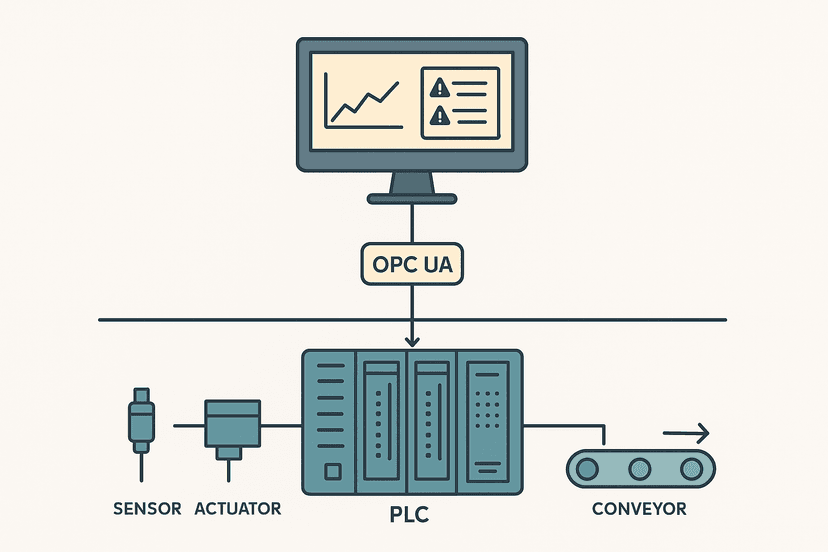
For plant-level data integration, OPC UA has become the common bridge. A DCS historian and a PLC-based SCADA historian both expose OPC UA servers that feed MES and ERP systems. SCADA communication protocols covers this in more detail if you need to design the data architecture above the control layer.
Safety Systems: Neither PLC nor DCS by Default
One thing both camps agree on: your basic control system, PLC or DCS, should not be your Safety Instrumented System. SIS functions (emergency shutdown, fire and gas, burner management) run on separate, certified safety controllers that are architecturally independent from the basic process control. Whether the BPCS is a PLC or a DCS, the SIS sits beside it, not inside it. If you are specifying safety functions, the IEC 62061 SIL levels guide is a solid starting point.
Quick Decision Guide: PLC or DCS?
- Discrete machine control, any size: PLC.
- Continuous process, under 2,000 I/O, team has PLC skills: PLC plus SCADA.
- Continuous process, 2,000 to 5,000 I/O: evaluate both seriously, cost and skills drive the answer.
- Continuous process, over 5,000 I/O, high availability required: DCS is the default unless you have a compelling reason not to.
- Regulated batch process (pharma, food) needing native audit trails: DCS.
- Greenfield plant with no existing vendor commitment and a mixed process: consider a hybrid, PLC for machine areas, DCS for process units, with OPC UA tying them together.
Keep Learning
If you are building out a PLC-based system and need to understand the layers above the PLC, start with how SCADA and PLC work together on the plant floor. For the I/O module side of PLC architecture, types of PLC modules gives you the hardware picture. And if you are working on a Siemens platform and evaluating where to draw the line between S7-1200 and S7-1500 for a process application, the S7-1200 vs S7-1500 comparison covers that decision in detail.
Was this helpful?