S7-1200 vs S7-1500: Which Siemens PLC to Choose
If you are specifying a Siemens project right now, you have almost certainly asked yourself: S7-1200 or S7-1500? The question comes up constantly, and the honest answer is not one-size-fits-all. Both platforms live in TIA Portal, both speak PROFINET, and both run IEC 61131-3 code. But underneath that shared surface there are real differences in scan speed, memory, motion capability, safety options and price that will bite you if you pick wrong.
What Is the Difference Between S7-1200 and S7-1500?
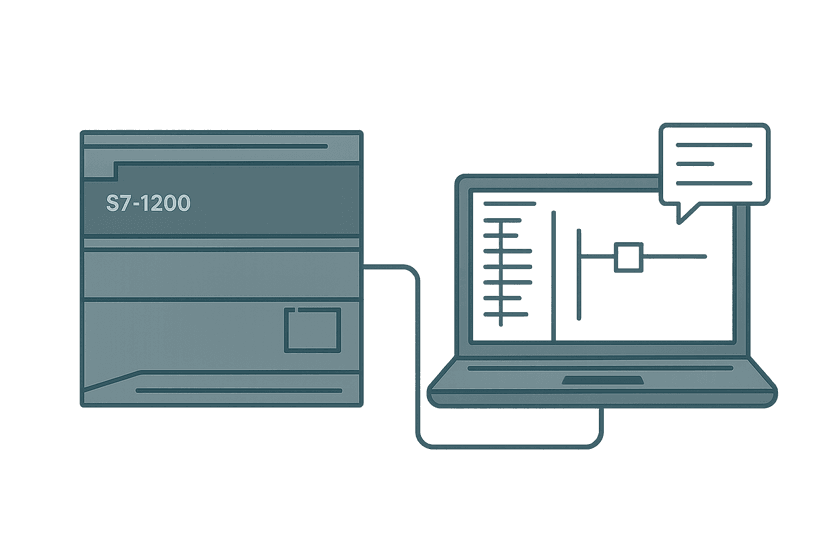
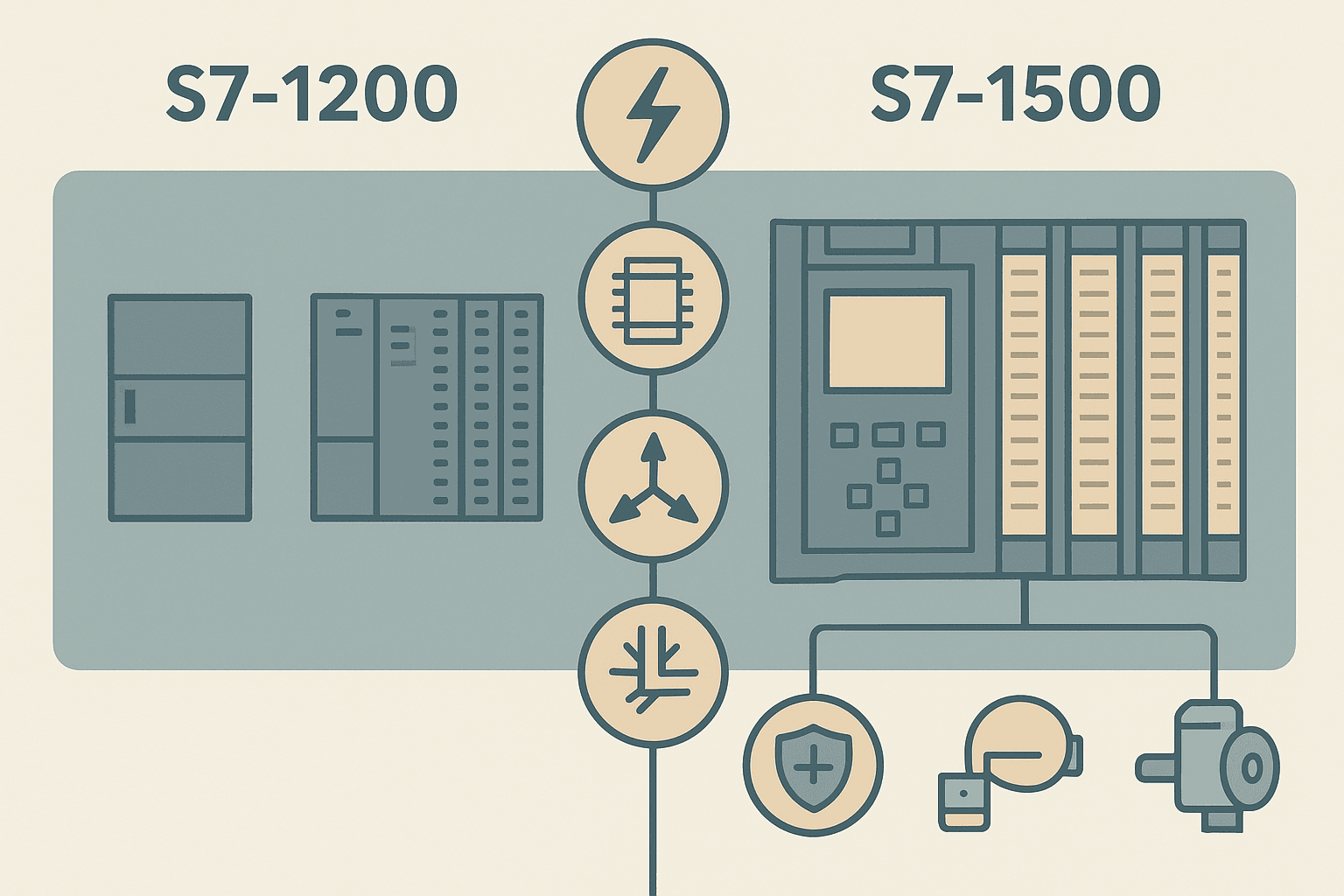
The S7-1200 is Siemens' compact, cost-optimized controller aimed at small to mid-size standalone machines. The S7-1500 is a modular, high-performance platform built for demanding process applications, multi-axis motion, distributed I/O at scale and integrated functional safety. Both run in TIA Portal V16 and above, but the S7-1500 offers faster scan times, far more working memory, a built-in diagnostic display, broader motion-axis counts and a wider F-CPU safety portfolio than the S7-1200 can match.
Hardware Overview: What You Actually Get
The S7-1200 family tops out with the CPU 1215C and 1217C. These are compact units with onboard I/O, two PROFINET ports (1215C/1217C) or one port (1211C, 1212C, 1214C), and signal board slots for analog or serial expansion. Maximum local I/O sits around 284 digital points across SB and SM expansion. It is a tidy package for a single machine cabinet.
The S7-1500 starts at the CPU 1511 and scales up to the CPU 1518. You get a rack-based system with no onboard I/O (the CPU itself carries no field terminals), a front-panel display on every variant, and a second PROFINET interface on most models. Many 1500 CPUs also support isochronous real-time (IRT) PROFINET, which is essential for tight motion synchronization. For PROFINET IO architecture at serious scale, the 1500 is the natural home.
| Feature | S7-1200 (1214C typical) | S7-1500 (1511-1 typical) |
|---|---|---|
| Work memory (code) | 100 KB | 150 KB (expandable to 1 MB on 1518) |
| Typical OB1 scan | 1 to 10 ms | Under 1 ms |
| PROFINET ports | 1 (2 on 1215C/1217C) | 2 (3 on some 1518 models) |
| Max PLCopen axes | 6 | Up to 128 |
| Built-in display | No | Yes |
| F-CPU (safety) option | 1214FC, 1215FC | Broad range, 1511F to 1518F |
Scan Time and Processing: Where It Actually Matters
On a packaging machine running a simple filling sequence, a 5 ms scan on an S7-1200 is perfectly fine. I have put dozens of 1214C units into standalone machines with 100-plus rungs and never had a timing complaint. But the day you need a closed-loop PID on a fast temperature zone or a motion profile tighter than a few milliseconds, you start to feel the ceiling.
The S7-1500's bit performance is roughly 10 times faster than the S7-1200 at the same price tier, and the higher-end 1516 and 1518 CPUs process floating-point in under a microsecond. If your application uses Structured Text in TIA Portal for math-heavy analog loops, that gap shows up quickly. For applications with PLC scan cycle sensitivity, the S7-1500 gives you real headroom.
Memory: The Hidden Bottleneck on the S7-1200
The S7-1200 carries 100 KB to 150 KB of work memory depending on the CPU. That sounds like plenty until you start adding TIA Portal data blocks for recipe management, historian buffers or large UDT arrays. I hit the ceiling on a 1214C once with a recipe system holding 50 product variants. We squeezed through by stripping unnecessary comments and splitting DBs, but it was uncomfortable. The S7-1500 CPU 1511 starts at 150 KB and the 1518 goes to 1 MB, which is a fundamentally different conversation.
Motion Control: Six Axes vs Hundreds
Both platforms use PLCopen motion function blocks in TIA Portal, so the programming model looks the same. You call MC_MoveAbsolute, MC_MoveVelocity and friends whether you are on a 1200 or a 1500. The differences are in scale and synchronization. The S7-1200 supports up to six technology objects per CPU. That covers a gantry, a rotary indexer or a small multi-axis cell without any trouble.
The S7-1500, especially with isochronous PROFINET IRT, can synchronize dozens of axes to sub-millisecond jitter. For the kind of coordinated motion you need on a multi-axis robot cell or a continuous-web printing machine, the 1500 is the right tool. If you want to understand how those PLCopen motion blocks actually work before you commit hardware, that is worth reading first.
Safety Integration: F-CPU Choices on Each Platform
The S7-1200 offers fail-safe CPUs in the 1214FC and 1215FC variants. These run standard and safety programs in the same CPU and communicate with PROFIsafe devices over PROFINET. For a machine with an E-stop circuit, a light curtain and a safety gate, the 1214FC is fully capable and considerably cheaper than the equivalent S7-1500 F-CPU.
Where the S7-1500 F-CPUs win is in diagnostic depth and SIL ceiling. The 1500F lineup supports applications up to SIL 3 per IEC 62061 and PLe per ISO 13849. The safety editor in TIA Portal Safety Advanced integrates more tightly with the 1500 hardware for large F-program memory requirements. If your safety relay wiring is growing into a full safety PLC requirement, and your IEC 62061 SIL level assessment points toward SIL 2 or SIL 3, plan for the 1500F from the start. Retrofitting safety onto a 1200 project mid-way through is painful.
PROFINET and Communications Depth
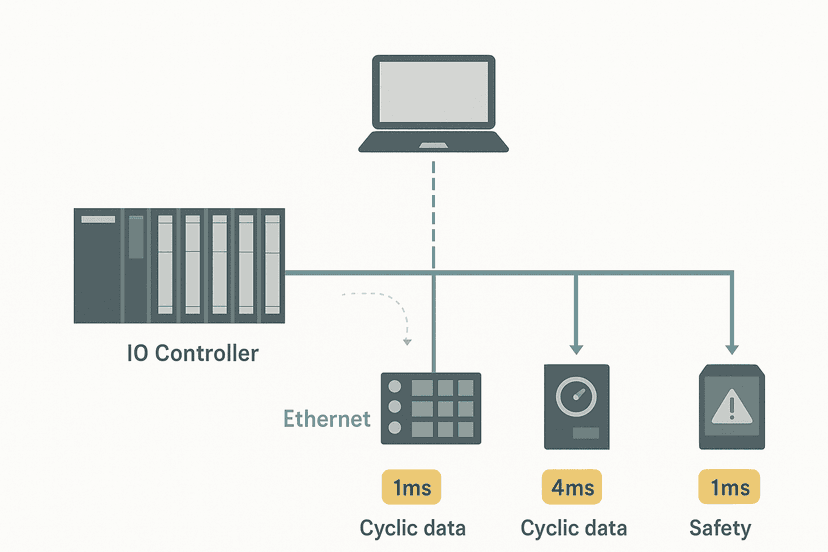
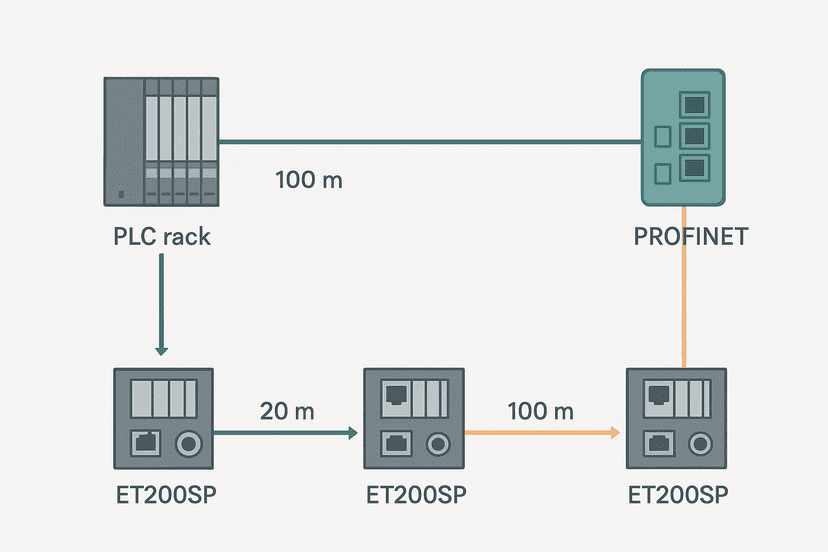
Both platforms act as PROFINET IO controllers. The S7-1200 handles up to 16 IO devices, which covers most standalone machine topologies. The S7-1500 supports significantly more devices, adds a dedicated second PROFINET interface for ring topology or separate machine and drive networks, and supports IRT for deterministic motion. If you are building a PROFINET wiring topology across a large plant with many remote ET 200 drops, the 1500 gives you more room.
On the serial and fieldbus side, both support Modbus TCP natively. For Modbus RTU you need a CM 1241 RS485 module on the 1200 or a CM on the 1500. OPC UA server capability exists on the S7-1500 natively; on the S7-1200 it was added in firmware 4.4 but with tighter limits on the number of nodes.
Price: The Real-World Gap
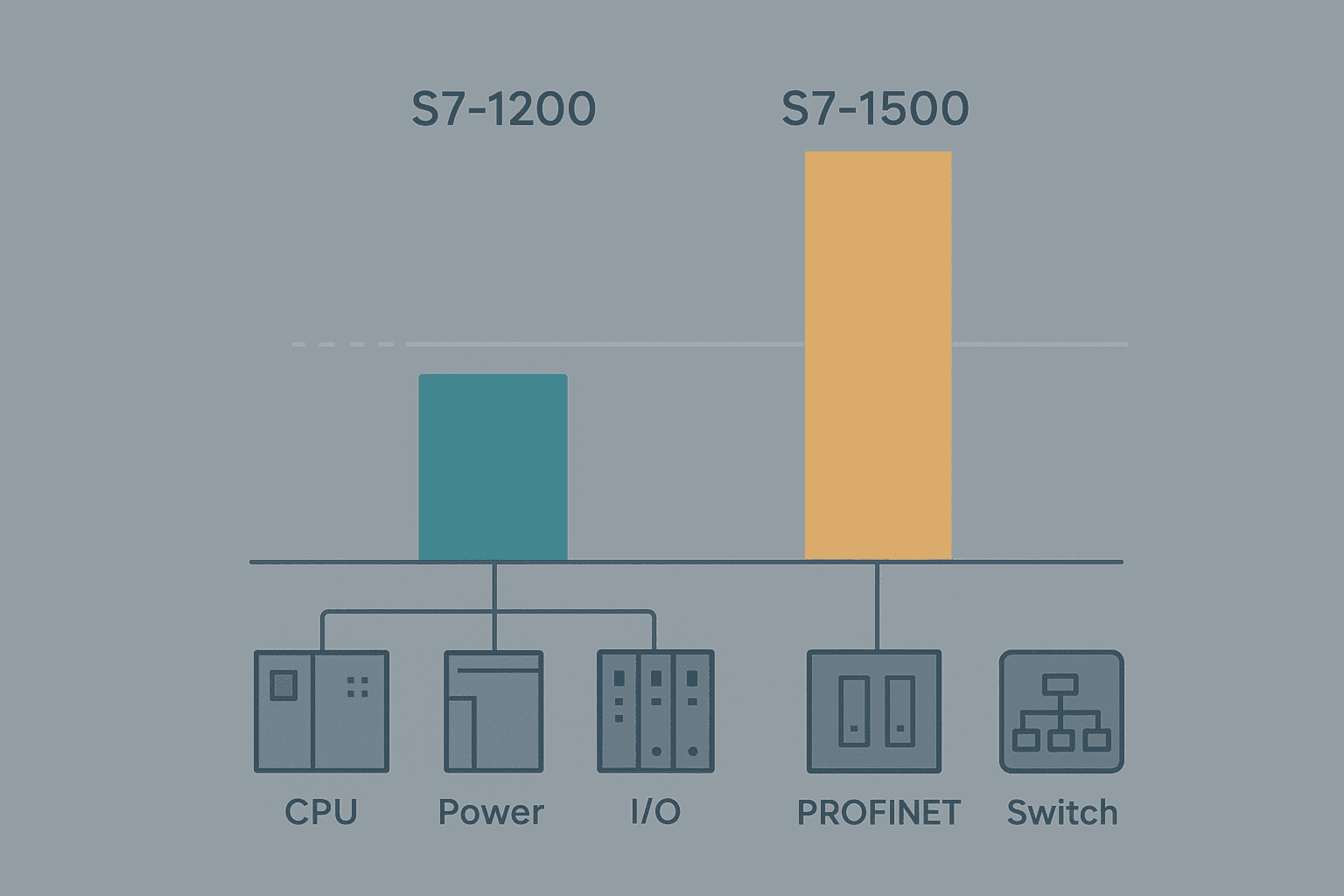
A CPU 1214C DC/DC/DC lists in the 300 to 400 USD range depending on region and distributor. A CPU 1511-1 PN lists closer to 800 to 1000 USD. Add the PS 60W power supply the 1500 needs (the 1200 runs directly off 24 VDC without a separate PS module) and the price gap widens further. For a machine that genuinely only needs the 1200, spending the extra on a 1500 is waste. But if you size a 1200 too tightly and end up adding a second CPU or a CP communications module to compensate, you will spend more than if you had just started with the 1500.
The Decision Framework: A Practical Checklist
Use the S7-1200 when all of the following are true: fewer than six motion axes, no SIL 3 safety requirement, fewer than 16 PROFINET IO devices, scan time tolerance above 1 ms, and total program memory below 100 KB. It handles PLC analog input wiring, standard digital I/O with sinking or sourcing modules, and a connected HMI through TIA Portal HMI programming without any difficulty.
Move to the S7-1500 when any of these apply: more than six axes or IRT synchronization needed, SIL 2 or SIL 3 safety program required, more than 16 PROFINET devices, scan time below 1 ms for a control loop, large DB memory requirements (recipe systems, historian pre-buffering), or you need the front-panel display for commissioning and maintenance staff in the field. The display alone has saved me hours on large sites where laptop access to TIA Portal is not always convenient.
- Choose S7-1200: standalone machine, up to 6 axes, budget-sensitive, scan > 1 ms acceptable
- Choose S7-1500: multi-axis motion with IRT, SIL 2/3 safety, large PROFINET topology, sub-millisecond loops
- Choose S7-1500: project likely to grow, diagnostic display needed on the floor, OPC UA server with many nodes
- Avoid: sizing a 1200 so tightly that you add modules to compensate; recalculate total cost first
One Field Lesson Worth Remembering
On a filling line I commissioned a few years back, the customer wanted to save money and pushed for a 1214C on a six-axis servo application with PROFINET drives. We got it working, but with six technology objects and a recipe DB the CPU was consistently at 85% memory utilization. Every firmware update needed a careful memory audit before upload. Six months later they added two more axes to the line and we had to swap the CPU for a 1511 anyway. The total cost of that swap, including re-commissioning time, exceeded the original price difference between the two CPUs. Pick the right platform for where the machine is going, not just where it starts.
What to Read Next
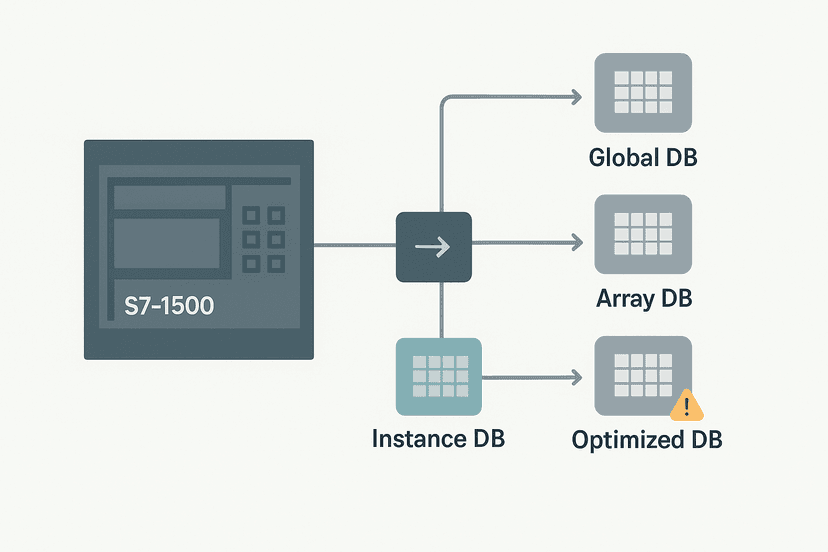
If you have settled on the S7-1200, the S7-1200 first program in TIA Portal gets you writing code in an afternoon. For understanding how to structure your program properly on either platform, TIA Portal data blocks explained covers DB types and when to use each. And once your network is running, PROFINET communication loss diagnosis will help you track down the faults that show up on every first commissioning.
Frequently asked questions
What is the main difference between the S7-1200 and S7-1500?
Can the S7-1200 run PROFINET IO as a controller?
Is the S7-1500 worth the extra cost for a simple machine?
Does the S7-1200 support Safety Integrated (Fail-Safe)?
How many motion axes can the S7-1200 control?
What programming languages work on both platforms?
Can I migrate an S7-1200 project to an S7-1500 later?
What is the cycle time difference between S7-1200 and S7-1500?
Does the S7-1500 have a built-in display?
Which platform is better for a first Siemens project?
Learn this by building it
There is a PLC in this site. It runs a real scan engine, checks your logic against the same tests a working machine would fail, and needs no download and no account.
Open the exercisesFree, no signup, runs in your browser. See all 16 exercises.
Was this helpful?