PLC vs PAC vs DCS: Which Controller Do You Need?
You have been handed a new project. The process engineer says it needs PID loops, the reliability manager insists on redundancy, and your controls budget is tighter than you would like. Someone in the meeting says 'should we use a DCS?' and suddenly everyone is looking at you. This post gives you a straight answer to that question, plus an honest look at where PACs fit in.
What Is the Difference Between a PLC, PAC, and DCS?
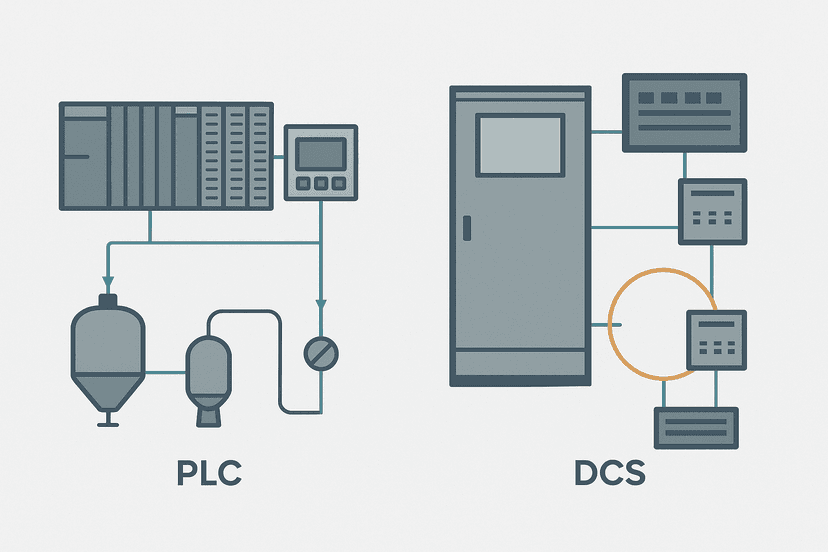
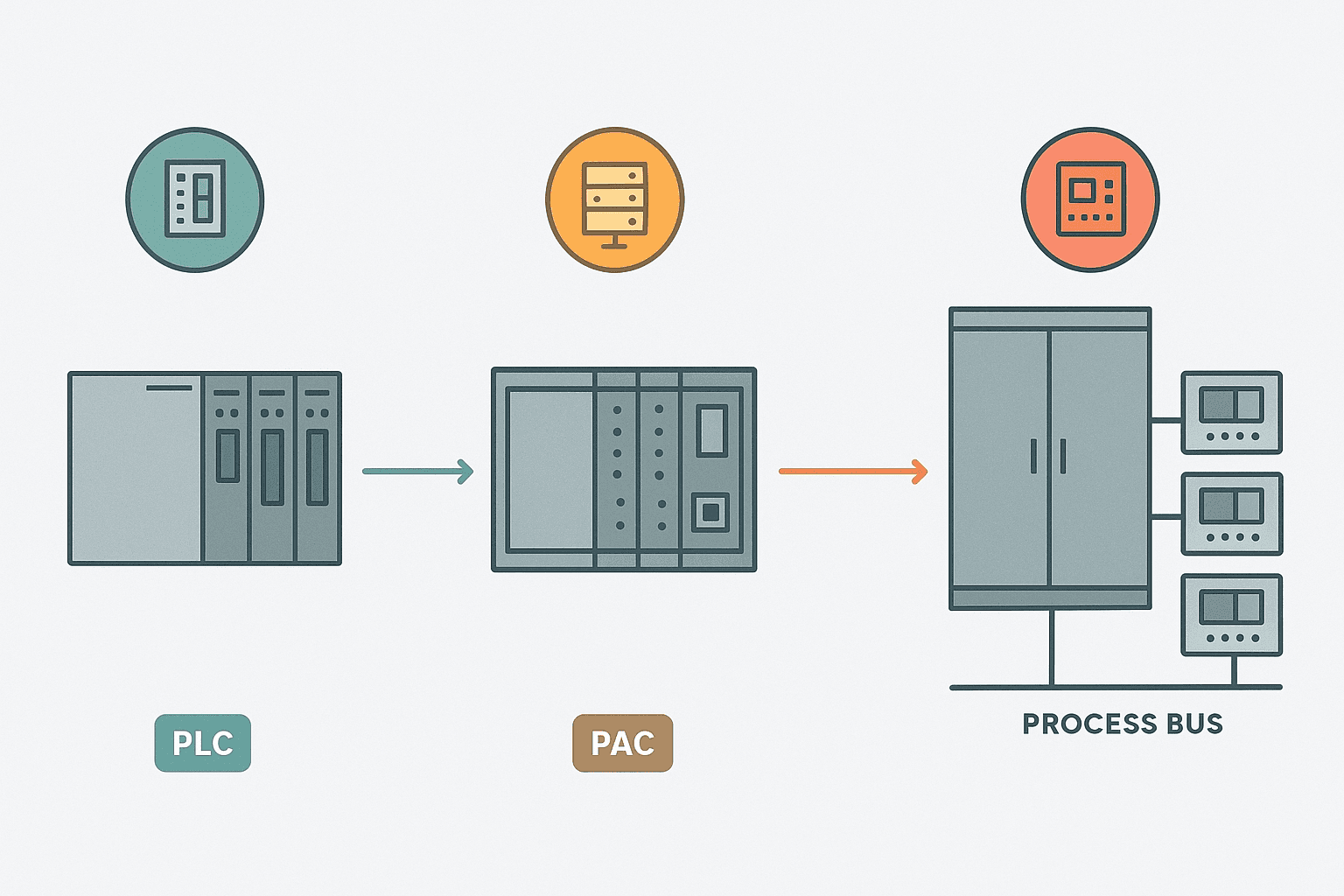
A PLC (Programmable Logic Controller) is a dedicated industrial computer built to execute a scan-based control program reliably in harsh environments, primarily for discrete event control. A PAC (Programmable Automation Controller) is a high-capability PLC that handles discrete, process, and motion control in one chassis using a tag-based data model and multiple IEC 61131-3 languages. A DCS (Distributed Control System) is an integrated system where control is distributed across field controllers tied to a shared process database, engineered as a complete plant-wide solution with built-in redundancy, alarm management, and historian functions.
A Short History: Why Three Names Exist
PLCs were invented in the late 1960s to replace relay panels in automotive factories. They were deliberately fast, rugged, and simple to program in ladder logic. DCS platforms emerged a few years later from the process industries, where the priority was continuous regulatory control, not fast discrete switching.
The PAC label was coined around 2001 by the ARC Advisory Group to describe a new generation of controllers that blurred the PLC/DCS boundary. Rockwell ControlLogix, Siemens S7-400 and S7-1500, and GE's RX3i all got called PACs at various points. Honestly, the term has never been standardized, and most engineers today use PLC and PAC interchangeably for high-end controllers. But the DCS distinction still matters, because the architecture is genuinely different.
PLC vs PAC: Are They Actually Different?
Short answer: less and less. A compact fixed PLC like a Siemens S7-1200 or an Allen-Bradley Micro820 is clearly a PLC. A Rockwell ControlLogix L8x or a Siemens S7-1500 CPU with a large I/O rack, multiple programming languages, and motion integration is what most people mean when they say PAC. You can read more about how those high-end Siemens CPUs compare in S7-1200 vs S7-1500: Which Siemens PLC to Choose.
The practical differences that do remain: PACs tend to use tag-based addressing rather than fixed memory offsets (no more N7:0), support more programming languages natively per IEC 61131-3, handle larger I/O counts gracefully, and often include built-in motion axes. For the rest of this article, I will use PLC and PAC as a combined category versus DCS, because that is the comparison that actually matters on most projects.
Architecture: Where the Real Difference Lives
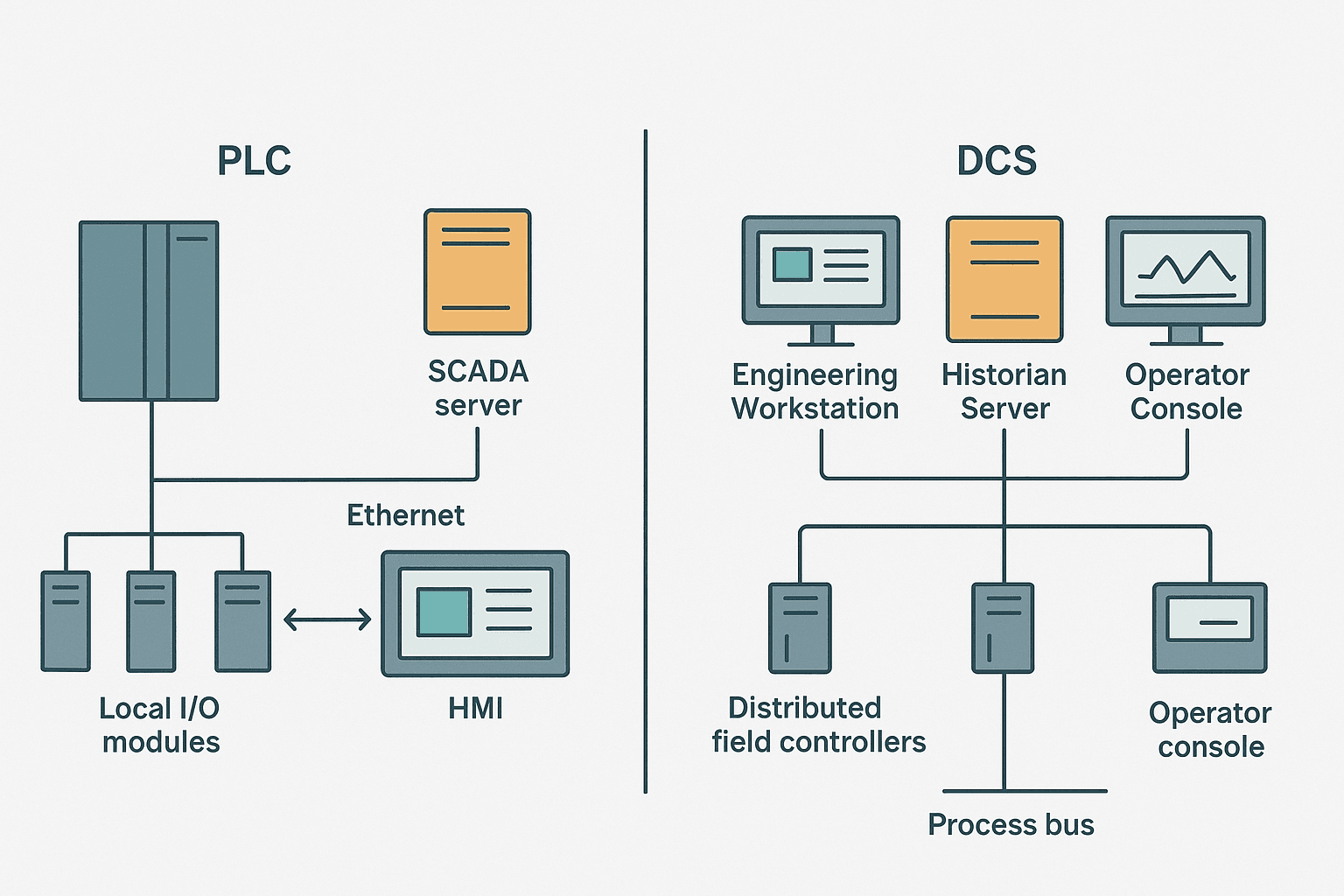
A PLC-based system is typically built bottom-up. You pick a CPU, add I/O modules, write your program, and connect to an HMI or SCADA system separately. The SCADA layer and the historian are third-party additions. Alarm management is something you design yourself, and if you get it wrong you end up with a nuisance alarm problem like the one described in SCADA Alarm Management.
A DCS is engineered top-down. You start with a plant-wide tag database. Every field device gets a tag. The controllers, HMI displays, historian, and alarm system all reference that same database. Add a new transmitter, and it appears everywhere automatically. That integration is the DCS's biggest practical advantage, and it is also why DCS projects have a different feel: you configure rather than program, at least for standard loop control.
Scan Time and Control Loop Performance
PLC scan times for discrete logic typically run 1 to 20 ms. Motion control tasks can go below 1 ms. For analog process control, a PLC running a PID instruction every scan is usually faster than any physical process needs.
DCS controllers often execute at 100 to 500 ms module periods for regulatory control. That is not a weakness; it is a deliberate design choice. A temperature loop on a large reactor vessel has a process time constant measured in minutes. Scanning it every 200 ms is perfectly adequate and allows the DCS to service thousands of loops across distributed field controllers without overloading any single CPU.
Where PLC scan cycle behavior can trip you up is when you mix fast discrete tasks with slower analog processing in the same program. If you have not read about PLC scan cycle timing faults, that is worth understanding before you start adding lots of PID loops to a machine controller.
Redundancy: Honest Comparison
Redundancy is where DCS systems historically had a clear advantage. Redundant controllers, redundant I/O buses, and redundant power supplies were designed in from the start on platforms like Honeywell Experion, Emerson DeltaV, and Yokogawa CENTUM. Bumpless transfer on controller failure was a selling point from day one.
Modern PLC/PAC platforms have caught up considerably. Rockwell ControlLogix Redundancy, Siemens S7-400H, and Beckhoff TwinCAT with redundant EtherCAT all offer hot-standby CPU redundancy. But you typically pay a significant premium for redundant PLC hardware, and the configuration is more complex than on a DCS where redundancy is the default. If your process cannot tolerate a controller restart, budget for that engineering effort on either platform.
I/O Count and Scalability
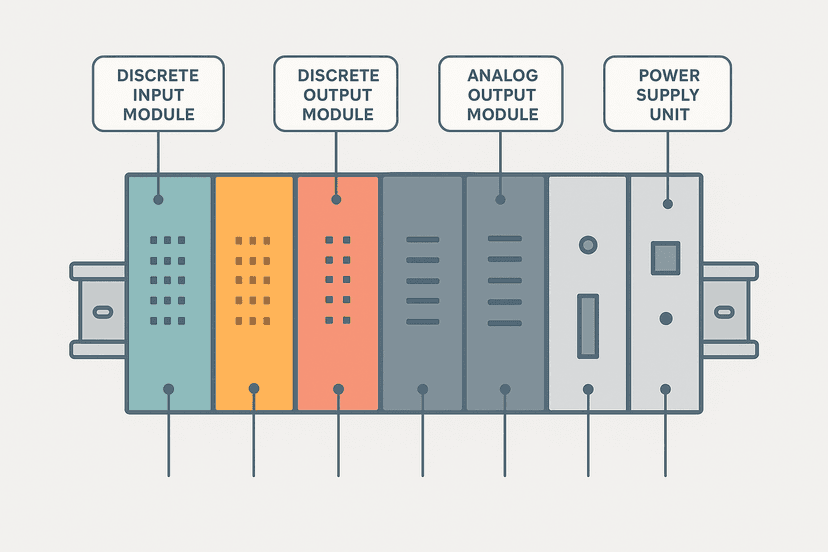
PLC systems scale well from 10 I/O points to a few thousand, particularly with distributed I/O over PROFINET or EtherNet/IP. The types of PLC modules available now cover almost every signal type. But managing 5,000 tags across a dozen PLCs with no shared database is an engineering project in itself.
DCS platforms are designed for large I/O counts. Some installations run tens of thousands of I/O points on a single DCS backbone. The shared tag database and bulk engineering tools (like faceplates, bulk import from instrument lists) make large-scale projects manageable in a way that a fragmented PLC system would struggle to match.
| Factor | PLC / PAC | DCS |
|---|---|---|
| Typical scan time | 1-20 ms discrete, <1 ms motion | 100-500 ms regulatory loops |
| I/O count sweet spot | 10 to ~5,000 points | 500 to 50,000+ points |
| Redundancy | Available, but adds cost and complexity | Built-in as standard on most platforms |
| Programming style | Program-centric (ladder, ST, FBD) | Configuration-centric + custom logic |
| Tag database | Per-controller, linked via SCADA | Plant-wide shared database |
| Typical upfront cost | Lower hardware cost | Higher, but includes integrated tools |
PLC vs DCS vs PAC: Which One Should You Choose?
Here is how I think about it on a new project. Start with the dominant control task.
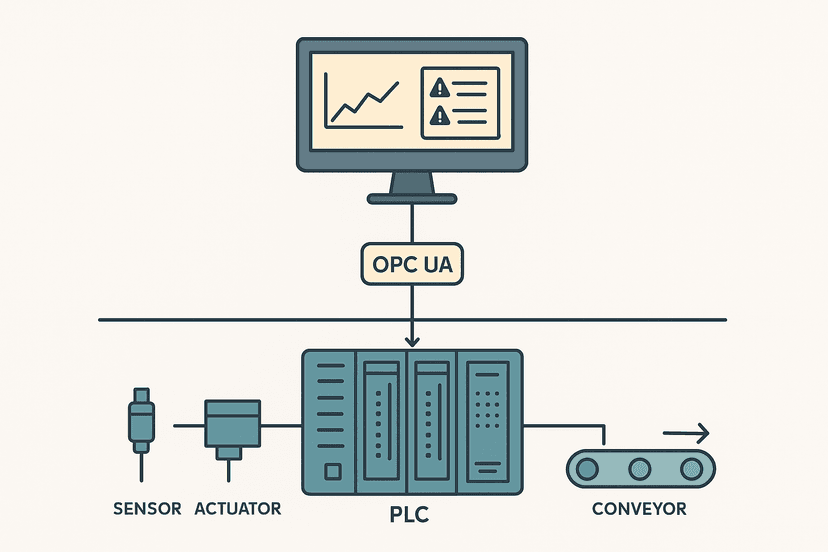
- Mostly discrete, some analog (packaging, assembly, material handling): PLC or PAC. Fast scans matter, the process is event-driven, and a DCS would be overkill. Connect to SCADA via OPC UA or EtherNet/IP.
- Continuous process with many PID loops, high reliability demand, large I/O count (refinery, chemical plant, power generation): DCS. The integrated engineering, alarm management, and redundancy save more money over the plant lifetime than the higher upfront cost.
- Mixed application with significant motion, complex logic, and moderate process control (food and beverage, pharmaceutical skids, batch reactors up to ~500 I/O): PAC is the natural fit. A ControlLogix or S7-1500 handles all three domains in one chassis.
- High safety integrity required: Neither choice replaces a dedicated safety controller. Check IEC 62061 SIL levels and keep safety logic in a dedicated SIL-rated controller regardless of your base platform.
Communications and Integration
PLC-based systems typically communicate via standard industrial Ethernet protocols. EtherNet/IP is dominant in Rockwell ecosystems (see EtherNet/IP Scanner vs Adapter), while Siemens leans on PROFINET (see PROFINET IO: Controller, Device and AR Explained). Fieldbus standards like Modbus RTU are common for legacy devices.
DCS systems use proprietary backplane buses internally (Honeywell's FTE, Emerson's FOUNDATION Fieldbus or HART-over-DeltaV, Yokogawa's Vnet/IP) and increasingly support OPC UA for integration with external systems. HART and FOUNDATION Fieldbus integration is generally better out of the box on DCS platforms, which matters if you have hundreds of smart field instruments.
Analog Signal Handling
Both platforms handle 4-20 mA signals. On a PLC, you wire the transmitter to an analog input module and scale the raw counts to engineering units yourself (the 4-20 mA scaling formula and ST and ladder scaling examples cover that in detail). On a DCS, the I/O module often does the scaling automatically once you enter the range in the tag configuration, which reduces programming work but also reduces visibility into what is happening under the hood.
HMI and Operator Interface
A PLC system needs a separate HMI or SCADA layer. That is additional software, additional licensing, and additional tag mapping work. The HMI tag linking process and HMI screen design considerations are real engineering tasks that take time. A DCS typically includes operator workstations and display tools as part of the platform, with the tag database already connected. That integration is genuinely valuable on a large project.
The Honest Bottom Line
The PLC vs PAC distinction is mostly marketing at this point. The PLC vs DCS distinction is real and architectural. Choose a PLC or PAC when discrete logic dominates, the I/O count is manageable, you need fast scan times, or budget is tight. Choose a DCS when you have a large continuous process, need integrated redundancy and alarm management from day one, and your instrument count is in the hundreds or thousands. And if anyone tells you one is universally better than the other, they are selling you something.
Keep Learning
If you are building a PLC-based system and need to understand how it connects to higher-level monitoring, start with SCADA vs PLC: How They Work Together on the Plant Floor. For a deeper look at how the DCS and PLC comparison plays out on a specific project type, the PLC vs DCS: Key Differences and How to Choose post covers the decision framework in more detail. And if you are evaluating Siemens hardware for a PAC-class application, S7-1200 vs S7-1500: Which Siemens PLC to Choose will help you size the right CPU.
Frequently asked questions
What is the main difference between a PLC and a DCS?
What is a PAC and how does it differ from a PLC?
Is DCS better than PLC for process control?
What scan time can I expect from a PLC vs a DCS?
Can a PLC replace a DCS?
What does PAC stand for in automation?
Which is more expensive, PLC or DCS?
What industries commonly use DCS instead of PLC?
Learn this by building it
There is a PLC in this site. It runs a real scan engine, checks your logic against the same tests a working machine would fail, and needs no download and no account.
Open the exercisesFree, no signup, runs in your browser. See all 16 exercises.
Was this helpful?